Site Utility Contractor in St. Louis
Kuesel is a St. Louis site utility contractor that self-performs water mains, sanitary and storm sewer, force mains, fire lines, and electrical and telecom conduit for commercial, industrial and municipal sites. As an Underground Utility Contractor, we build that pipe on the same schedule as our grading.
- One crew for water, sewer, storm, fire and conduit
- Scheduled with the earthwork and grading
- Bids confirmed within 1 business day
- MSD vendor
- PWSD prequalified
- ASTM C76, C443, F477, D3034, F679 cited
- Union: Operating Engineers Local 513 · Laborers Locals 110/42/660 · Teamsters · Plumbers & Pipefitters UA Local 562
- Since 1963
- 1 business day bid response
What Site Utility Work Includes
Site utilities are everything underground between the public systems in the street and the building: the pipe, structures and conduit a site needs before it can be occupied. On most of our jobs that package is water, sanitary, storm and fire, plus the electrical and telecom duct bank that feeds the building. Our own crews install all of it.
Water Mains & Services
We install water mains, valves, hydrants, domestic water services and fire lines from the main to the building, built to the standards of the water provider that will own the main. Each new main is pressure tested, flushed and disinfected before service. See water main installation.
Sanitary Sewer
We build gravity sanitary mains, manholes and building laterals, including deep sewer where grades require it. Lines are tested to the sewer owner's specifications before acceptance, commonly with line testing, manhole testing and video inspection. See sanitary sewer.
Storm Sewer & Detention
We install storm pipe, inlets, junction boxes, headwalls and outlet structures, and build detention, underground detention and bioretention. See storm sewer and bioretention basins.
Force Mains
Where a site can't drain to a gravity sewer, wastewater is pumped through a force main to the nearest gravity line. We install force mains, the valves and fittings along them, and the connections at both ends. Force mains are pressure tested to the owner's specifications before they go into service.
Fire Lines
We install fire protection water services — the underground line from the water main to the building's fire riser — along with fire hydrants and valves. Fire lines are flushed and hydrostatically tested before the riser connection, and the test is commonly witnessed by the local fire authority or water provider. We plan the hand-off point with the fire sprinkler contractor so the building's fire protection isn't held up.
Electrical & Telecom Conduit / Duct Bank
We install underground electrical and telecom conduit, including concrete-encased duct banks, handholes and pull boxes. Conduit runs are typically proved clear before backfill and left with pull strings for the electrical contractor. More on utility trenching and duct bank installation.
What we don't self-perform
Trenchless crossings and directional drilling are coordinated through partner contractors. Inside the building line, the plumbing and electrical trades take over from the stub-outs and conduit we leave at the building.
Site Utilities for Data Centers, Industrial & Commercial Sites
Data center campuses put more pipe and conduit in the ground per acre than almost any other site type. Duct bank is often one of the largest underground scopes, and it has to be coordinated with storm, sanitary, water and fire lines running through the same corridors. Our mission critical site work includes generator yard duct banks and hardstands.
Industrial plants and distribution buildings need long storm runs, detention, fire loops and domestic water sized for the operation, often on a pad we graded ourselves. Commercial sites such as retail, convenience stores with fuel stations and multi-family communities are smaller but tighter, with storm structures, underground detention and short service runs squeezed between parking, drives and building pads.
General contractors
One sub for the whole underground package, tied into the site schedule.
Developers
Utility routes and depths reviewed early, so budgets hold.
MEP subcontractors
Trenching, bedding and backfill for electrical and plumbing crews.
Municipalities
Water, sewer and storm work built to the owner's standards.
Industrial & data center owners
Duct banks, fire lines and process utilities on tight schedules.
How We Run a Utility Package
1. Preconstruction — we review the civil plans, utility profiles and depths, flag conflicts with the grading plan, and price the package in HCSS HeavyBid. We confirm whether we're bidding within 1 business day.
2. Layout and locating — a locate request goes in through Missouri One Call, or JULIE in Illinois, before any digging, and our in-house hydrovac daylights existing lines where the new work crosses them.
3. Install — pipe is bedded, laid to grade and backfilled to the project specifications, with pipe grade set by laser and GPS and checked as the line goes in.
4. Testing and inspection — water mains and fire lines are pressure tested, flushed and disinfected; sanitary lines get line testing, manhole testing and video inspection to the owner's specifications.
5. Tie-ins — connections to live mains and existing sewers are scheduled with the owning utility so service is disrupted as little as possible.
6. Restoration — trenches are compacted, and surfaces are restored so the next trade, or the paving crew, can follow.
Because the same company runs the earthwork and the utilities, trench spoil, pad elevations and utility depths are planned together instead of traded back and forth between subs.
Crews, Equipment & Technology
Utility work is done by our own union crews — a foreman running the crew, with our operators and laborers in the trench — backed by an owned fleet of 300+ machines. Every trench is protected according to OSHA excavation standards, using trench boxes, shoring or sloping as depth and soil require, and a competent person inspects excavations. Deep trenches, poor soils and rock are accounted for in the bid rather than discovered in the field.
Our own hydrovac trucks expose existing lines with water and suction instead of a bucket, so crossings are confirmed before the excavator arrives. GPS machine control verifies trench grades, and 24/7 fleet telematics track the equipment on every active site. See how that construction technology works across our jobs.
We also excavate, shore, bed and backfill trenches for electrical and MEP subcontractors, so their crews can focus on their own installation. If you have underground work, send us the scope.
Coordinating With Utilities & Agencies
Every utility on a site ends up owned or reviewed by someone else, so coordination is part of the job. Kuesel is a Metropolitan Sewer District (MSD) vendor, and in St. Louis City and most of St. Louis County, sanitary and stormwater work is reviewed by MSD. Our guide to MSD's 2027 rules covers the changes that reach sanitary and storm design, and our MSD work page covers the rest.
We are PWSD prequalified, and water mains are built to the standards of the water provider that will own them. Missouri One Call and JULIE handle locates before excavation, and fire line tests are commonly witnessed by the local fire authority or water provider.
Site Utility Projects in and near St. Louis
St. Louis County, MO
Data Center Site Development
Site utilities for a data center campus: more than 3,600 LF of storm with three bio-retention ponds, 30" PE sanitary sewer and an 8" C900 water main, plus a fire line.
View projectFenton, MO
Freight Terminal Expansion
Utility package for a freight terminal building addition: more than 2,400 LF of storm sewer, two underground detention systems, sanitary and a new water main.
View projectColumbia, MO
Interstate Utility Relocations
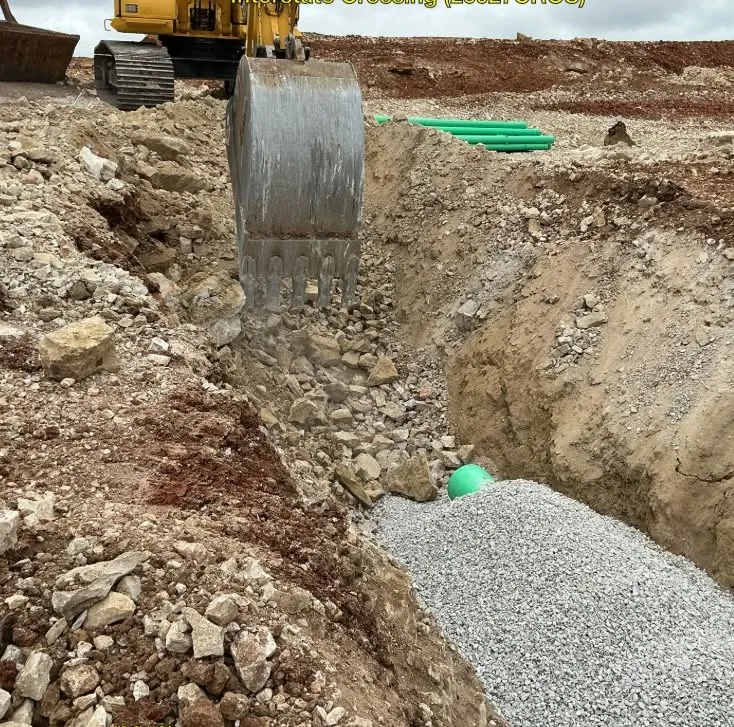
Utilities hydro-excavated first, then 745 LF of 8" sanitary relocated and about 400 LF of water main moved with a live tie-in for an interstate widening.
View projectCrestwood, MO
Convenience Store & Fuel Station
About 1,360 LF of storm, eight manholes, two hydrodynamic separators and underground detention, with a 6" sanitary service and domestic water for a convenience store and fuel station.
View project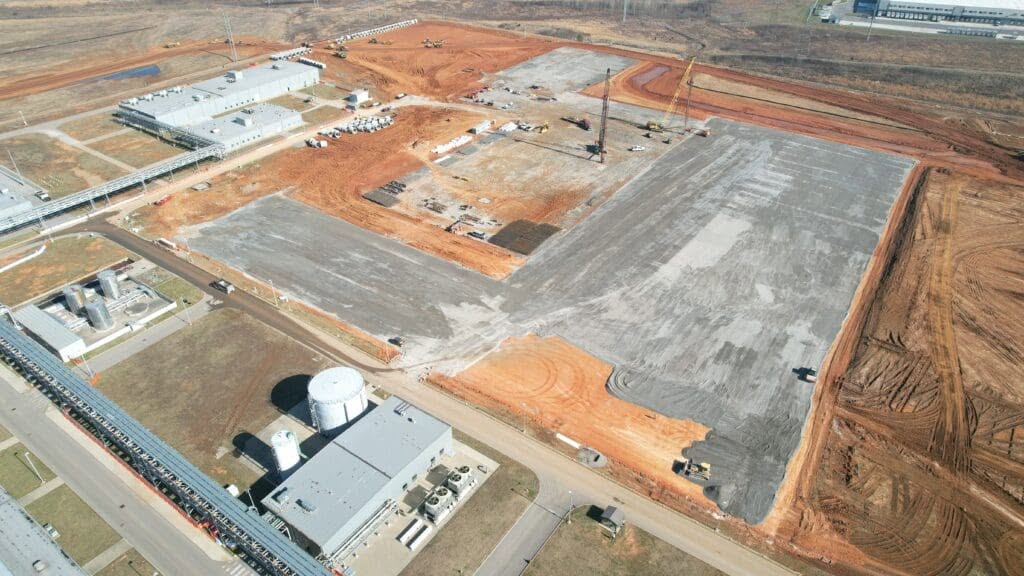
Clarksville, TN
Clarksville Tire Plant Expansion
Self-performed site utilities and soil stabilization for the 1.4M sq ft Clarksville tire plant expansion, with existing utilities located by hydro excavation before deep pits were cut.
View projectSt. Louis, MO
Institutional Building Basement & Utilities
Site utilities for a new institutional building, with hydro excavation near existing lines: storm, an underground detention system, sanitary, water and fire.
View project
More completed work on our projects page.
Site Utility FAQs
- What does a site utility contractor do?
- A site utility contractor installs the underground systems that connect a building to public services: water mains and services, sanitary and storm sewer, detention, force mains, fire lines, and electrical and telecom conduit and duct bank. Kuesel does this work with its own crews from its base in O'Fallon, MO.
- Do you self-perform water, sanitary and storm?
- Yes. Our own crews and equipment install water mains and services, gravity sanitary sewer, manholes and laterals, storm sewer and detention, and force mains. Kuesel is an MSD vendor and PWSD prequalified.
- Do you install fire lines and duct bank?
- Yes. We install fire lines from the main to the building's fire riser, with hydrants and valves, and underground electrical and telecom conduit, including concrete-encased duct banks, handholes and pull boxes. Trenchless or directional drilling is coordinated through partners.
- Do you work on data center sites?
- Yes. Our utility work on a St. Louis data center campus included more than 3,600 LF of storm with three bio-retention ponds, 30" PE sanitary sewer, an 8" C900 water main and a fire line. Our mission critical site work also includes generator yard duct banks and hardstands.
- How far from St. Louis do you work?
- We work across St. Louis, St. Charles County, the greater St. Louis metro and the Illinois Metro East, and travel for large projects of roughly $20M and up (e.g. in Indiana, Kentucky and Tennessee).
- How do I get a site utility bid?
- Send the plans and scope through our Request a Bid form. We confirm whether we're bidding within 1 business day. Office hours are Monday–Friday, 7:00 AM–4:00 PM.
Where We Work
Our shop is at 854 Lone Star Drive in O'Fallon, MO. Most utility packages we build are in St. Louis, St. Charles County and the rest of the greater St. Louis metro, including the Illinois Metro East. Kuesel also travels for large projects of roughly $20M and up (e.g. in Indiana, Kentucky and Tennessee) — a tire plant in Clarksville, TN is one example.
Site utilities across the region.
St. Louis County
- Site utilities in Florissant, MO
- Site utilities in Chesterfield, MO
- Site utilities in Wildwood, MO
- Site utilities in Ballwin, MO
- Site utilities in Maryland Heights, MO
- Site utilities in Hazelwood, MO
- Site utilities in Creve Coeur, MO
- Site utilities in Manchester, MO
- Site utilities in Clayton, MO
- Site utilities in Fenton, MO
- Site utilities in Berkeley, MO
- Site utilities in Crestwood, MO
- Site utilities in Town and Country, MO
St. Charles County
- Site utilities in O'Fallon, MO
- Site utilities in St. Charles, MO
- Site utilities in St. Peters, MO
- Site utilities in Wentzville, MO
- Site utilities in Lake Saint Louis, MO
- Site utilities in Dardenne Prairie, MO
- Site utilities in Cottleville, MO
- Site utilities in Weldon Spring, MO
- Site utilities in New Melle, MO
- Site utilities in Foristell, MO
- Site utilities in Augusta, MO
Metro East Illinois
Jefferson, Lincoln & Boone Counties
Need building plumbing on the same project? We refer interior and commercial plumbing to Legacy Plumbing, which handles scheduled commercial plumbing service Mon–Fri, 7:00 AM–4:00 PM, with 24/7 emergency calls answered.