
Written and reviewed by the Kuesel field operations & estimating team
Last reviewed:
Kuesel is a family-owned site work and utility contractor based in O'Fallon, MO, building sites across St. Louis since 1963.
Rock and unsuitable soils are the two site conditions most likely to turn a sound budget into a change order. Neither can be fully known before digging, so the goal isn't to eliminate the risk. It's to size it, price it fairly, and decide in advance who carries it. This guide covers how owners, engineers and GCs can do that.
Know what the borings can and can't tell you
Borings show conditions at points. Between them, rock surfaces can rise and fall and soft zones can come and go. Refusal in a boring tells you something hard was hit at that depth, but not always whether it is solid rock, a boulder, or weathered material that can be dug. Ask the geotechnical engineer to say how confident they are between borings, and where more information would help.
Test pits: the cheapest risk reduction
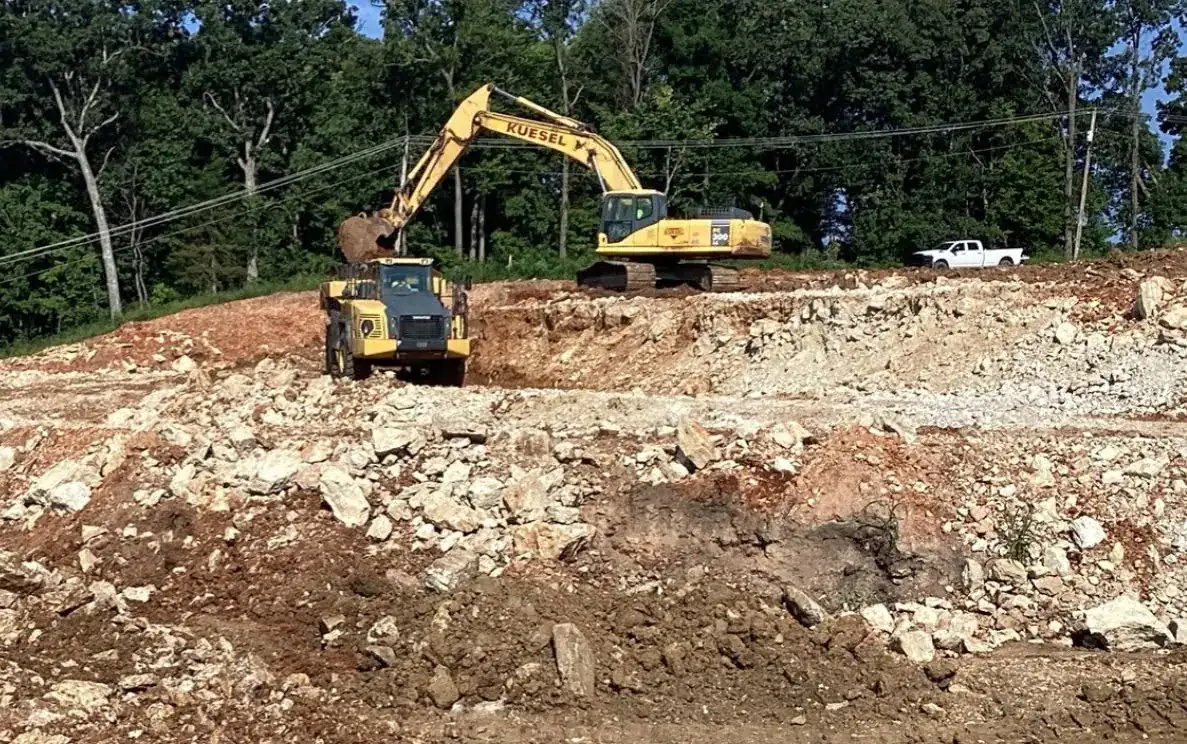
An excavator digging test pits in the deepest cuts and along the main utility routes shows what the ground looks like, and how hard it is to dig, in a way borings can't. Test pits are quick and inexpensive compared with a rock surprise during construction. Call 811 / Missouri One Call for locates first, and follow OSHA trenching and excavation guidance for any pit that crews enter.
- Dig where cuts and trench depths are deepest
- Log depth to rock and how it was removed (bucket, ripper, or hammer)
- Photograph soil layers and note moisture and any old fill
- Share the logs with every bidder
Scope the geotech for the questions you have
A geotech scope written only for building foundations may not answer site questions. Consider asking for:
- Borings in paving areas and along major utility runs, not just pads
- Borings that extend below the deepest planned trench
- Moisture content and plasticity testing on the clays
- Recommendations for both undercut and in-place stabilization
- Guidance on whether on-site soils can be reused as fill
Use unit prices for rock and unsuitables
When quantities are uncertain, lump-sum pricing forces every bidder to guess, and the guesses get padded. A better approach is to carry rock excavation and unsuitable-soil removal as unit prices with an estimated quantity, measured in the field. The owner pays for what is actually found, and bidders compete on the same basis.
For unit prices to work, the contract has to define what counts. Common items to settle up front:
- What qualifies as rock (for example, material that can't be removed with the specified equipment)
- Separate prices for mass rock and trench rock, since trench rock is usually more costly
- How quantities are measured and who verifies them
- Who decides a soil is unsuitable, and how deep undercuts are directed
- What backfill or replacement material is paid with the undercut
Price stabilization as an alternate to undercut
If the geotech engineer allows it, treating soft or wet clay in place with lime or cement can replace some or all of an undercut. On large areas it often avoids hauling spoils out and fill in. On small, scattered soft spots, undercut can be simpler. Pricing both on the same quantities lets the owner choose with real numbers.
Our lime vs. cement vs. undercut guide explains each method. Kuesel self-performs soil stabilization and full-depth reclamation, so we can price both options.
More on soil stabilization in St. Louis.
Common mistakes
- Pricing rock from pad grades only, when the rock is in the utility trenches
- Assuming refusal in a boring always means solid rock
- Leaving "unsuitable" undefined, so every soft spot becomes an argument
- Writing one rock price for mass and trench rock
- Carrying no alternate to undercut on a site with large areas of wet clay
- Skipping test pits to save time, then losing more time to a surprise in the field
Each of these shifts risk onto whoever has the least information when the contract is signed. The fixes are mostly about writing things down clearly before bidding: where the risk is, how it will be measured, and how it will be paid.
Carry the risk in the pro forma
Until test pits or construction confirm conditions, a developer's budget should carry a contingency sized to the risk, not a flat percentage. Sites with shallow refusal in several borings or wet, high-plasticity clays warrant more. A site contractor who has reviewed the geotech can help size it. That's part of our Early Site Budget for developers.
We work on sites across St. Louis, Chesterfield and Columbia. Related reading: what drives site development cost, balancing cut and fill, and the full resources library.
Questions
- Should rock be bid lump sum or unit price?
- When the amount of rock is uncertain, unit prices with an estimated quantity are usually fairer. Bidders compete on the same basis and the owner pays for what is actually found.
- Are test pits worth it if we already have borings?
- Usually. Test pits show what the ground looks like and how hard it is to dig between borings, especially in deep cuts and along utility routes.
- Can soil stabilization replace an undercut?
- Sometimes. It depends on the soil, the geotech recommendations and the area involved. Pricing both on the same quantities shows which is better for your site.
- Who decides when soil is unsuitable?
- The geotechnical engineer or the owner's testing agency, according to the project specifications. The contract should say how that decision is made and measured.
This guide is general information from a site contractor, not engineering or legal advice. Your engineers and the reviewing agencies set the requirements for your project.