Sanitary Sewer Contractor in St. Louis
Kuesel builds sanitary sewer for developers, general contractors and owners on private commercial and industrial sites around St. Louis. Our own crews install gravity sanitary mains, manholes and building laterals, run deep sewer where the grades call for it, make the connections and tie-ins to existing lines, and build force mains and lift stations where a site can't drain by gravity. Every line is tested to the sewer owner's specifications before it is accepted.
Get a Bid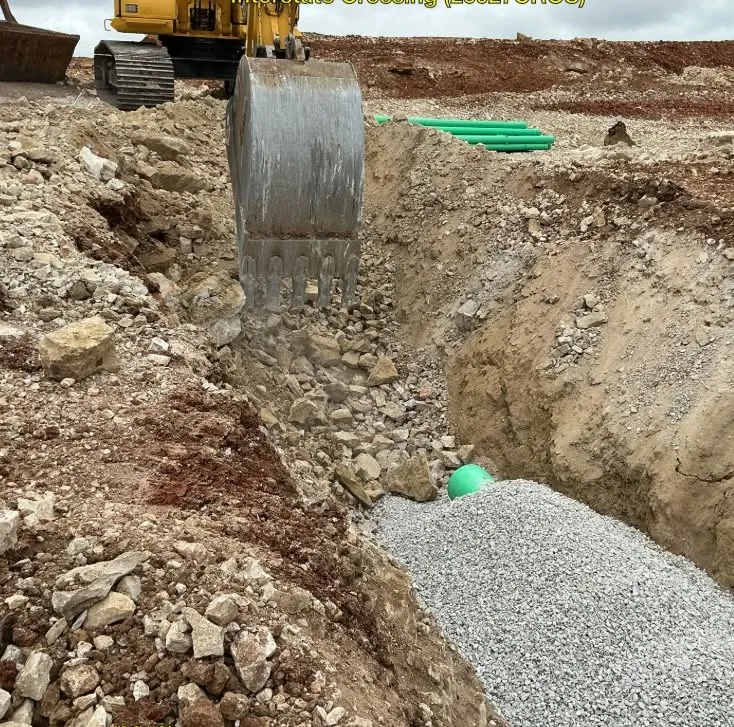
Supporting credentials: MSD (Metropolitan Sewer District) vendor · PWSD prequalified contractor · Self-performed since 1963
Mains, manholes and laterals.
Most of the sanitary sewer we build is gravity pipe: a main laid on a steady slope from the high end of the site down to the point of connection, with manholes at the changes in direction and grade, and a lateral from the main to each building. On a new commercial pad that can be a single service line; on a multi-building development it is a full network of main, manholes and service wyes.
Gravity sewer only works if the grade is right, so grade control is the core of the job. We set pipe grade with lasers and GPS, check it as the line goes in, and bed and backfill the pipe to the project specifications so the line passes its tests the first time instead of being dug back up.
- Gravity sanitary mains
- Manholes and drop connections
- Building laterals and service wyes
- Connections and tie-ins to existing sewer
When the grades require going deep.
Some sites can't reach the existing sewer at a typical depth. Long runs, flat ground, or a connection point that sits high relative to the buildings push the main deeper. Deep sanitary work is slower, needs more trench protection and leaves more spoil to manage, so it belongs in the budget from the start rather than as a change order.
Every trench we open is protected to OSHA excavation standards with trench boxes, shoring or sloping as the depth and soil require. When existing lines cross the route, we expose them first with our own hydrovac potholing, and every dig starts with a locate request through Missouri One Call. Sanitary is one part of the package we self-perform as an underground utility contractor, alongside water and storm.
Force mains and lift stations.
Where a building or a whole development sits below the sewer it has to reach, wastewater is collected at a lift station and pumped through a force main to the nearest gravity line. Lift stations are part of our water and sewer scope, along with the force main, the valves and fittings along it, and the connections at both ends.
Force mains are pressure tested before they go into service, to the owner's specifications, and we coordinate the gravity tie-in with the sewer owner so the connection is made with as little disruption as possible.
Tested before the owner accepts it.
A sanitary sewer isn't finished when the trench is backfilled. It is inspected and tested to the sewer owner's specifications before acceptance, and that commonly includes line testing, manhole testing and a video inspection of the pipe. We schedule those tests with the owner's inspector and keep the line clean so the video shows the pipe, not construction debris.
Utility work is built to the standards named in the project specifications, such as MSD standard specifications and the ASTM pipe and joint standards called out on the plans.
MSD's 2027 rules and sanitary work.
In St. Louis City and most of St. Louis County, sanitary sewer is reviewed by MSD. Plans first submitted to MSD on or after January 1, 2027 fall under MSD's 2027 Rules and Regulations and Engineering Design Requirements, and two of the changes reach directly into sanitary work.
First, the 2027 rules require strapped plumbing for new buildings: basement-level fixtures drain to a pump in a sealed sump that discharges to an overhead line, instead of draining straight to the sewer. On site, that means the plumber's sump and overhead line have to line up with the lateral we bring to the building. Second, the rules allow MSD to consider a sanitary sewer shallower than the usual minimum depth where all upstream development has strapped plumbing, which can change how deep a new main has to run. Our guide to MSD's 2027 rules explains both, and your civil engineer and MSD confirm what applies to your plans.
Sanitary sewer projects.
Most of our jobs combine earthwork, storm, sanitary and water work under one crew.
Industrial Campus Sanitary Replacement — St. Louis, MO
On an active industrial campus in the City of St. Louis, inside MSD's area, a failed 15" sanitary main was replaced with 15" SDR 26, a 6" lateral was repaired and the street was restored with 10" of concrete under traffic control. MSD-reviewed sanitary work.
View project →Build-to-Rent Sanitary Main — Wentzville, MO
For a build-to-rent community in St. Charles County, about 1,700 LF of 12" PVC sanitary main upsized from 10", with 28 service wyes, an inside drop and testing. A 526 LF segment with a grade conflict was lowered 2 feet and converted to C900.
View project →Freight Terminal Expansion — Fenton, MO
Site clearing, mass grading and a structural fill pad, with storm, detention, sanitary and water.
View project →Development Utility Site Package
A large water main job that also included earthwork, storm sewer and sanitary sewer work.
Sanitary sewer questions.
- What does a sanitary sewer contractor build on a commercial site?
- On a private commercial or industrial site, a sanitary sewer contractor builds the gravity main, manholes and building laterals that carry wastewater from the buildings to the existing sewer, plus any force main and lift station the site needs. Kuesel self-performs this work with its own crews.
- How is a new sanitary sewer tested before acceptance?
- It is tested to the sewer owner's specifications. That commonly includes line testing, manhole testing and a video inspection of the pipe, scheduled with the owner's inspector before the sewer is accepted.
- Do you install lift stations and force mains?
- Yes. Where a site can't drain by gravity, we build the lift station and the force main to the nearest gravity line, including the valves, fittings and connections at both ends. Force mains are pressure tested before service.
- Does MSD's 2027 rulebook change sanitary work?
- For plans first submitted to MSD on or after January 1, 2027, yes. The 2027 rules require strapped plumbing for new buildings, and MSD may consider shallower sanitary sewers where all upstream development has strapped plumbing. Your civil engineer and MSD confirm what applies.
- Do you build sanitary sewer outside MSD's area?
- Yes. MSD covers St. Louis City and most of St. Louis County. We also build sanitary sewer in St. Charles County and elsewhere in the region, to the standards of whichever sewer owner will accept the line.
Read before you build.
Capabilities under this service line
- Gravity sanitary sewer mains
- Manholes
- Building laterals and service wyes
- Deep sanitary sewer where grades require it
- Connections and tie-ins to existing sewer
- Force mains
- Lift stations
- Line testing, manhole testing and video inspection
Sanitary Sewer in action

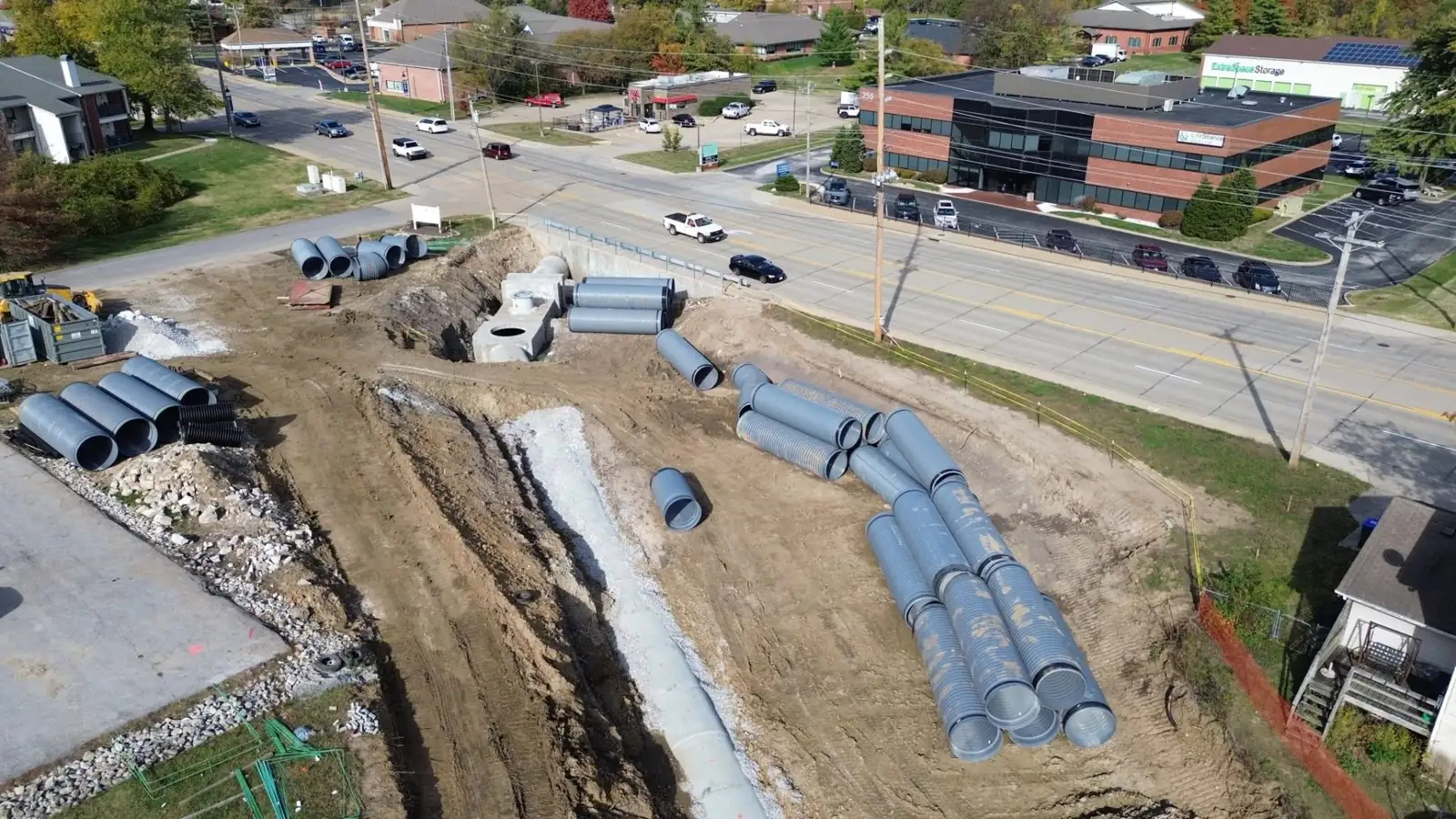
- 01Gravity mains, manholes, laterals, force mains and lift stations by our own crews
- 02Grade set with lasers and GPS so the line passes testing the first time
- 03Line testing, manhole testing and video inspection scheduled with the sewer owner's inspector