
Written and reviewed by the Kuesel field operations & estimating team
Last reviewed:
Kuesel is a family-owned site work and utility contractor based in O'Fallon, MO, building sites across St. Louis since 1963.
Plans first submitted to MSD on or after January 1, 2027 fall under the new 2027 rules; plans submitted before then stay under the 2018 rules. That is MSD's own rule for which version of its Rules and Regulations and Engineering Design Requirements applies, and it means your submittal date decides your rulebook.
Three changes matter most on a private site. Detention and water-quality features are sized to larger design storms, so basins and BMPs may get bigger. New buildings need strapped plumbing for basement-level fixtures. And new storm sewers must connect continuously to the existing system next door.
Kuesel is the site contractor that builds MSD-reviewed sewer and stormwater work for private projects. We are not a design firm, and this summary is not engineering or legal advice. Confirm design questions with your civil engineer and with MSD.
Which rules apply to your project
MSD decides which rules apply by the date plans are first submitted, not by the date they are approved or built. The test is simple:
| Initial plan submittal to MSD | Rules that apply |
|---|---|
| Before January 1, 2027 | 2018 Rules and Regulations and Engineering Design Requirements |
| On or after January 1, 2027 | 2027 Rules and Regulations and Engineering Design Requirements |
Timeline
MSD released the 2027 draft dated July 1, 2026. Public comments closed September 1, 2026, and MSD posted its responses to the comments on October 15, 2026. Some provisions changed after comment, and those changes are noted below. Plans first submitted on or after January 1, 2027 fall under the new rules. As of November 9, 2026, MSD's website still labels the 2027 document a draft and the schedule as proposed, so check MSD for the final version.
MSD's 2023 Standard Construction Specifications are a separate document. The rules and design requirements decide how a system is designed; the construction specifications govern how it is built.
The changes at a glance
The table compares the 2018 rules with the 2027 draft and shows what MSD did after public comment. MSD's own BMP pages may still show the 2018 numbers, so check the rules document itself.
| Change | 2018 rules | 2027 rules | Section | After public comment |
|---|---|---|---|---|
| Water quality volume (WQv) rainfall, 90th percentile event | 1.14 in. | 1.25 in. (Lambert data 1975–2025, about 10% more) | 4.060.02 | Kept; max ponding depths for filter-only BMPs rise to match |
| Detention design rainfall, 24-hour | 2-yr 3.1 in.; 100-yr 7.2 in. | 2-yr 3.2 in.; 100-yr 7.8 in. (NOAA Atlas 14) | 4.060.02 4b(1) | Kept; NRCS Type II distribution and IDF curves unchanged |
| 1-year, 24-hour rainfall (channel protection) | 2.50 in. | 2.8 in. | 4.060.02 3b(2) | Kept |
| Channel protection volume (CPv) on multi-drainage-area sites | "May" be distributed proportionally | "Must" be distributed proportionally to each drainage area | 4.060.02 3b(6) | Kept |
| Basement backflow protection | Backwater valve or strapped plumbing per local code (per the draft's struck text) | Strapped plumbing for all new buildings; other permitted discharges: strapped plumbing, an approved backwater valve, or none if the plumbing authority finds it impractical | Chapter 3 | Kept |
| Sanitary sewer depth | 9 ft minimum for extendable sewers; basement low point at least 2.5 ft plus pipe diameter above flowline | Shallower than 9 ft may be considered where all upstream development has strapped plumbing; the 2.5 ft basement rule applies to connections without strapped plumbing | 3.030.03 items 1–2 | Kept, with caution where existing buildings remain upstream |
| Storm sewer continuity | — | New storm sewers shall be continuous with existing adjacent systems | 4.020.06 item 6 | Kept and explained |
| Manhole wording | "Manholes" | Draft changed it to "access points" | — | Reverted to "manhole" |
| Inlet capacity at low points and grade pockets | "Should" provide additional capacity | "Shall" provide additional capacity | 4.030.04 | Changed to "shall" |
| Offsite sinkhole hydrologic-condition language | Existing language | Draft removed it | — | Restored |
| Levee districts (overflow) | Named list | "All current and future levee districts within MSD boundaries" | 4.020.11 | Will be added |
| Existing-condition credit for BMP sizing | — | Where there is downstream flooding or surcharging, the existing site may be treated as undeveloped | 4.060.01 item 2 | Clarified |
Stormwater changes
Stormwater is where the 2027 rules reach furthest into a site plan, because detention and water-quality features take land and drive grading.
Larger design storms for detention
Detention is now designed to NOAA Atlas 14 rainfall: the 2-year, 24-hour storm rises from 3.1 to 3.2 inches and the 100-year, 24-hour storm from 7.2 to 7.8 inches (4.060.02 4b(1)). MSD kept the NRCS Type II rainfall distribution and left its IDF curves unchanged, and has said it may revisit the numbers after NOAA Atlas 15.
Water quality volume rises from 1.14 to 1.25 inches
The rainfall depth used to size water-quality BMPs goes from 1.14 to 1.25 inches, based on Lambert rainfall data from 1975 to 2025 — about 10% more by MSD's own figure (4.060.02). MSD says maximum ponding depths for filter-only BMPs rise to match. For a bioretention basin, more water to treat can mean a larger footprint or a deeper design; your engineer decides which.
Channel protection must cover every drainage area
The 1-year, 24-hour storm used for channel protection rises from 2.50 to 2.8 inches (4.060.02 3b(2)). On sites with more than one drainage area, channel protection volume must now be distributed proportionally to each drainage area, where the 2018 rules said it "may" be (4.060.02 3b(6)). A site can no longer meet the requirement in one corner and leave another drainage area without it.
When existing pavement doesn't count
Where there is downstream flooding or surcharging, the existing site may be treated as undeveloped when BMPs are sized, which means no credit for existing pavement or roofs (4.060.01 item 2). MSD clarified this language after comment. On redevelopment sites, ask your engineer early whether it applies.
Put together, these changes mean basins and BMPs may get larger. How much depends on the site, so this guide gives no size or cost percentages; your civil engineer's design is the only reliable number.
Sanitary and basement changes
Strapped plumbing for new buildings
MSD's 2027 rules require strapped plumbing for basement-level fixtures in all new buildings: a pump in a sealed sump that discharges to an overhead line, so a sewer backup can't flow into the basement. For other permitted discharges, the rules allow strapped plumbing, a backwater valve approved by the plumbing authority, or no protection if that authority finds it impractical. MSD kept the requirement after public comment. MSD has also published a separate strapped plumbing requirements document. Flag strapped plumbing in the MEP scope early, because the sump, pump and overhead line are plumbing work that has to line up with the site lateral.
Sewer depth flexibility
The 2018 rules set a 9-foot minimum depth for extendable sanitary sewers and required a basement's low point to sit at least 2.5 feet plus the pipe diameter above the sewer flowline. Under the 2027 rules, MSD may consider sewers shallower than 9 feet where all upstream development has strapped plumbing, and the 2.5-foot basement rule applies to connections without strapped plumbing (3.030.03 items 1–2). MSD urged caution where existing buildings remain upstream. A shallower main can mean less excavation and trench protection, but only your engineer and MSD can confirm a site qualifies.
Storm sewer layout and structures
No more gaps: continuity with existing systems
New storm sewers shall be continuous with existing adjacent systems (4.020.06 item 6). The aim is to stop piecemeal systems that leave gaps between one project's pipe and the next. If the existing system sits at your property line or across a drive, plan for the connection in the design and the budget.
Inlets at sag points: "shall"
Inlets at low points and grade pockets shall provide additional capacity (4.030.04). The draft said "should"; MSD changed it to "shall" after public comment, so it is now a requirement rather than a recommendation.
What MSD changed after public comment
Most of the draft stayed as written, but MSD's October 15, 2026 responses made several changes:
- Manhole wording: the draft renamed manholes "access points"; MSD reverted to "manhole."
- Offsite sinkholes: the draft removed the hydrologic-condition language for offsite sinkholes; MSD restored it.
- Levee districts: MSD will add "all current and future levee districts within MSD boundaries" to the overflow provisions (4.020.11).
- Inlet capacity at sag points: "should" became "shall" (4.030.04).
- Existing-condition credit: MSD clarified when an existing site may be treated as undeveloped (4.060.01 item 2).
What this means on site
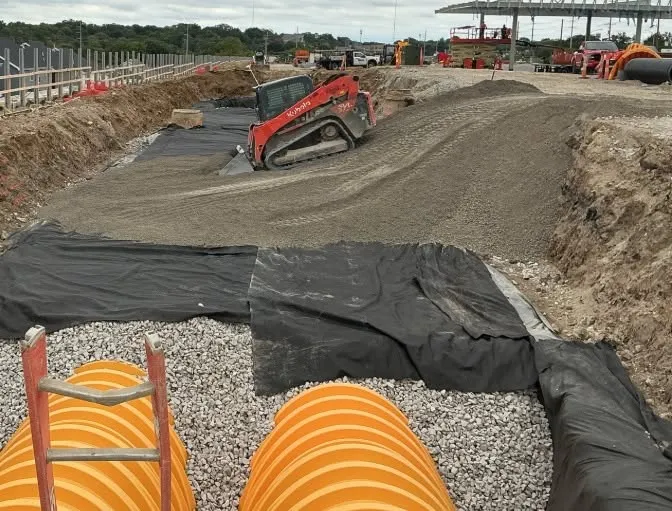
From the contractor's side, the 2027 rules show up as field coordination, not paperwork. Larger basins change the earthwork: more excavation, a different cut-and-fill balance and pad grading that has to work around a bigger footprint. Deeper or larger detention means more excavation and trench protection. Bioretention has to be built to the design and protected from sediment until the site is stable.
Strapped plumbing puts the plumber's sump and overhead line in the same conversation as the sanitary sewer lateral, and continuity rules can add a connection to the adjacent storm sewer. All of it gets inspected, so we coordinate with MSD inspection as the work goes in. Related services: water main installation, site utilities and water & sewer.
A checklist before and after Jan 1, 2027
- Confirm your initial submittal date with your civil engineer, and which rulebook that puts you under
- If you are near the deadline, weigh the trade-offs with your engineer; plans still have to be complete and ready for review
- Revisit basin and BMP footprints in the site plan against the larger design storms
- Flag strapped plumbing in the MEP scope for any new building with basement-level fixtures
- Ask whether the existing-condition credit applies on a redevelopment site
- Check where the adjacent storm system is and plan the continuity connection
- Bring your site contractor in during design so the earthwork balance and schedule reflect the final basin sizes — see preconstruction and site development cost drivers
Does this apply in St. Charles County or Illinois?
No. MSD's boundaries cover St. Louis City and most of St. Louis County. Sites in St. Charles County, other counties and Illinois are reviewed by other agencies and local governments. Our stormwater guide for developers explains who reviews what, and our post on land disturbance permits and stormwater requirements covers permit coverage.
More on the 2027 rules
Sources
MSD Project Clear: Rules and Regulations and Engineering Design Requirements, including the 2027 draft and MSD's October 15, 2026 responses to public comment. Last reviewed November 9, 2026.
This is not engineering or legal advice. Confirm design questions with your civil engineer and with MSD. MSD project on the boards? See our MSD work or contact us.
Questions
- Which MSD rules apply if I submit plans after January 1, 2027?
- MSD applies its rules based on the date plans are first submitted. Plans submitted before January 1, 2027 are reviewed under the 2018 Rules and Regulations and Engineering Design Requirements. Plans first submitted on or after January 1, 2027 fall under the 2027 version, which MSD released as a draft on July 1, 2026. MSD posted its responses to public comments on October 15, 2026.
- What are the biggest stormwater changes in MSD's 2027 rules?
- The 2027 draft raises the design rainfall MSD uses for site stormwater. The water quality volume rainfall goes from 1.14 to 1.25 inches. The 1-year storm goes from 2.50 to 2.8 inches, the 2-year storm from 3.1 to 3.2 inches, and the 100-year 24-hour storm from 7.2 to 7.8 inches, based on NOAA Atlas 14 and recent Lambert rainfall records. Channel protection volume must also be distributed to every drainage area on a site instead of optionally.
- Does MSD's 2027 draft require strapped plumbing?
- Yes, for new buildings. The draft requires basement-level fixtures in all new buildings to be protected by strapped plumbing, meaning a pump in a sealed sump that discharges to an overhead line. For other permitted discharges, it allows strapped plumbing, an approved backwater valve, or no protection if the plumbing authority finds it impractical. MSD kept this requirement after public comment.
- Will my BMPs or basins get bigger?
- They may. Larger design storms and a higher water quality rainfall depth mean more water to detain and treat. How much bigger depends on the site and design, so ask your civil engineer.
- Should we rush a submittal before January 1, 2027?
- That is a decision for you and your civil engineer. The rules that apply depend on the initial submittal date, but plans still have to be complete and ready for review, so weigh the trade-offs with your engineer.
- Do MSD's rules apply in St. Charles County or Illinois?
- No. MSD covers St. Louis City and most of St. Louis County. Other counties, St. Charles County and Illinois have their own reviewing agencies and local governments.
This guide is general information from a site contractor, not engineering or legal advice. Your engineers and the reviewing agencies set the requirements for your project.