
Written and reviewed by the Kuesel field operations & estimating team
Last reviewed:
Kuesel is a family-owned site work and utility contractor based in O'Fallon, MO, building sites across St. Louis since 1963.
MSD's 2027 rules add a handful of storm sewer requirements that show up directly in what gets built. New storm sewers must be continuous with the existing system next door. Inlets at low points must provide extra capacity, and MSD made that a "shall" after public comment. Flows over 4 cfs need area inlets or inlet manholes, with grates assumed half clogged. Pipes discharging at the top of a slope need erosion protection all the way to the bottom. And street-access manholes should be no more than 1,200 feet apart.
This guide is the storm sewer piece of our overview of MSD's 2027 rules. Kuesel builds storm and sanitary systems to the approved plans; your civil engineer designs them and MSD reviews them.
New storm sewers must connect to what's there
Section 4.020.06 of the draft adds: "New storm sewers shall be continuous with existing adjacent systems." Commenters asked what that meant. MSD's answer: the rule is meant to stop disjointed, piecemeal sections of storm sewer that don't connect to the existing system upstream or downstream, because small gaps create safety hazards, more blockages and more long-term maintenance.
In practice, if an existing storm line stops short of your property, or picks up again across a drive, expect the design to close the gap. That can add pipe, a structure, an easement or work in the right-of-way, so ask your engineer to locate the adjacent system early. Utility locating and potholing before design helps here; our hydrovac and specialty services can confirm what is actually in the ground.
Inlets: sags, big flows and grates
- Low points and grade pockets. Section 4.030.04 said inlets there "should" provide additional capacity. After public comment, MSD changed it to "shall."
- Flows over 4 cfs. The draft says area inlets or inlet manholes are required to intercept gutter or swale flow above 4 cfs, unless part of an approved BMP. Grate inlets are not recommended there; if allowed, they need side intakes, and the grates are assumed 50 percent clogged when sizing.
- What counts as a grate. MSD clarified in its responses that a "grate" means anything where flow must pass through a grated, meshed or screened opening, anything other than an open-throat inlet.
Outfalls on slopes
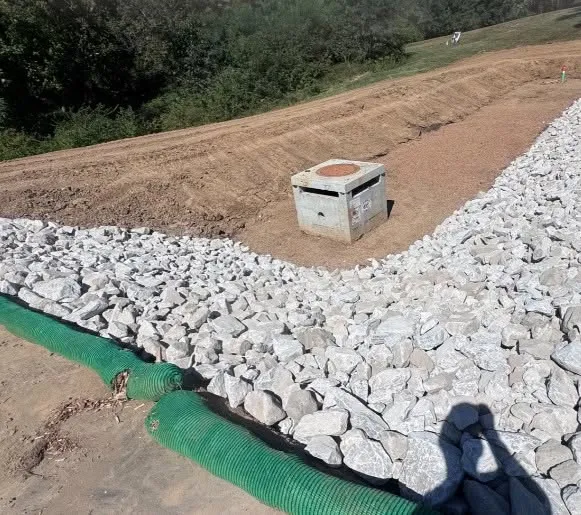
New item: storm sewer discharges at the top of or along a slope must include erosion protection from the end of pipe to the bottom of the slope. In some cases MSD may require a drop manhole with an outlet pipe that discharges at the toe of the slope. Price the riprap, or the extra structure, from the start.
Manholes and maintenance access
The draft adds that street-access manholes, meaning manholes in or next to a paved street MSD can reach, should be no more than 1,200 feet apart. MSD explained that its truck-mounted cleaning equipment reaches about 600 feet, so a manhole every 1,200 feet lets crews clean from both ends. The draft briefly renamed manholes "access points"; after comments, MSD said it would change the wording back to "manhole." MSD also confirmed no change to storm manhole and inlet diameters.
Sanitary sewers: no upsizing to flatten the slope
On the sanitary side, the draft adds that upsizing pipe diameter to use a flatter slope will not be allowed unless MSD decides it is needed to operate the system. MSD said in its responses that oversizing pipe where the flow does not need it creates maintenance problems. Shallower sanitary mains may be considered where all upstream development has strapped plumbing; see our main 2027 rules guide.
What to check on your plans
- Is the new storm system continuous with the adjacent system, upstream and downstream?
- Do sag inlets have the extra capacity the rules now require?
- Are flows over 4 cfs picked up by area inlets or inlet manholes?
- Do outfalls on slopes carry erosion protection to the toe?
- Are street-access manholes within 1,200 feet of each other?
Kuesel self-performs storm sewer, sanitary sewer and site utilities work across St. Louis City and County. See our MSD work or call 636-978-3478, Monday through Friday, 7:00 AM to 4:00 PM.
Questions
- What does "continuous with existing adjacent systems" mean in MSD's 2027 rules?
- MSD says the rule is meant to prevent disjointed, piecemeal sections of new storm sewer that don't connect to the existing system upstream or downstream, because gaps create safety hazards, blockages and added maintenance.
- When does MSD require area inlets instead of curb or grate inlets?
- Under the 2027 draft, flows greater than 4 cfs require area inlets or inlet manholes to intercept gutter or swale flow, unless part of an approved BMP. If grate inlets are allowed, they need side intakes and are sized assuming 50 percent clogging.
- How far apart should manholes be?
- The 2027 draft says street-access manholes should be no more than 1,200 feet apart. MSD noted its truck-mounted cleaning equipment reaches about 600 feet.
- Are MSD's 2027 rules final?
- As of November 9, 2026, MSD still labels them a draft. Its proposed schedule applies them to plans first submitted on or after January 1, 2027.
General information from a site contractor, not engineering or legal advice. Confirm design requirements with your civil engineer and MSD.