
Commercial Site Work in Festus, MO
Festus sits on the bluffs above the Mississippi River in Jefferson County, along I-55 about 44 miles (straight line) south-southeast of our O'Fallon headquarters. That puts it inside the St. Louis region we work in. Kuesel has been doing site work since 1963. In Festus that means mass grading, rock excavation, storm and detention, and water and sewer for developers and general contractors putting up commercial and industrial buildings. Our own union crews do the work.
Festus ground and Festus paperwork both have their own habits. This page covers what tends to shape a site budget and schedule here, so a project team can plan for it before bid day.
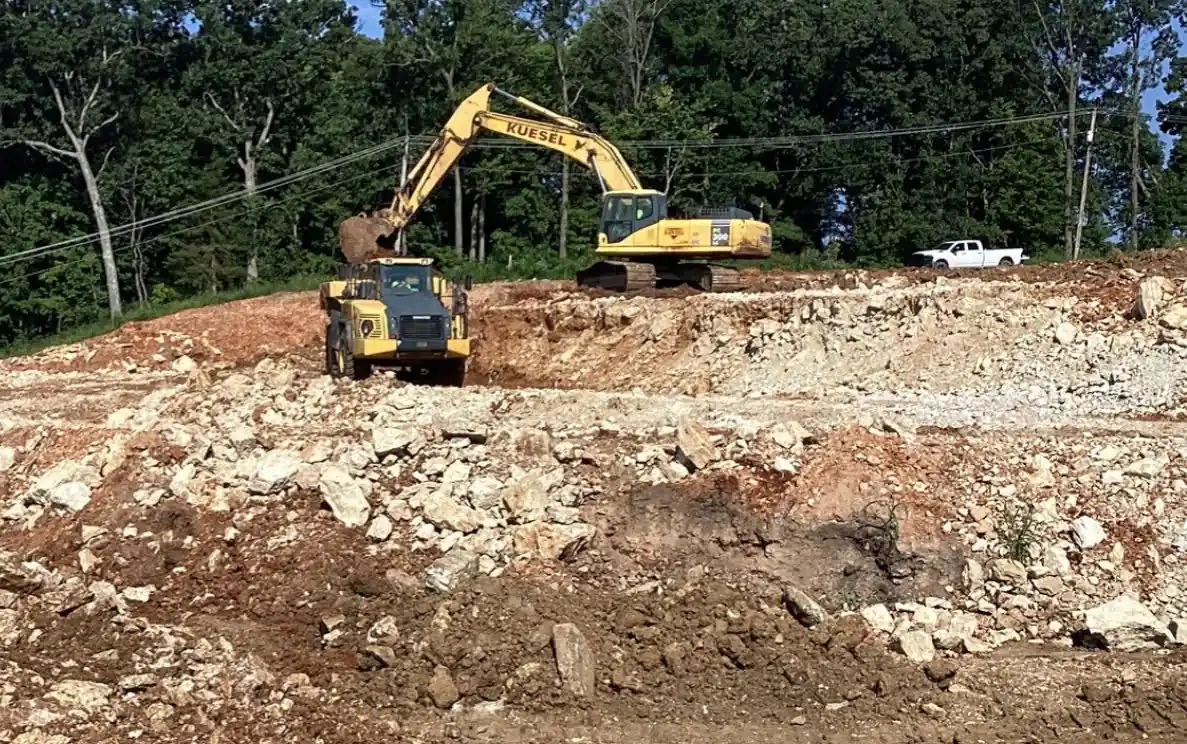
Two kinds of ground, sometimes on one site
Most of the uplands around Festus sit on the Jefferson City–Cotter dolomite. Federal studies of the nearby Hematite site describe this as dolostone and sandy dolostone with chert, under a fairly thin cover of soil. Down in the Joachim Creek valley it's a different story. The same studies found 17 to 45 feet of clay, silt, sand and gravel alluvium over the rock.
For a site plan, that usually means:
- Rock in the cuts on high ground. Mass rock and trench rock come out differently and cost differently, so they should be priced separately. Test pits along the deepest cuts and main utility routes are cheap insurance. See our rock and poor soils guide.
- Soft, wet soils in the bottoms. Alluvial clays and silts near the creek can pump under equipment. If the geotechnical engineer allows it, treating them in place with lime or cement can replace some undercut and haul-off. See soil stabilization.
- Karst. Dolomite dissolves, and Jefferson County has sinkholes. A depression found during clearing should get a geotechnical engineer's look before anyone fills it. See sinkhole and washout repair.
- Floodplain. Low ground along the creeks may fall under Festus's floodplain rules (Chapter 415). Check the FEMA map early, because it affects pad elevations and detention freeboard.
Festus detention rules worth knowing before layout
Festus Chapter 520 sets its own detention criteria. A few of them drive site layout:
| Criterion | Requirement |
|---|---|
| Sites under 20 acres | Rational formula, 15-year / 20-minute storm. Release is held to the pre-development rate, figured at 5% impervious. |
| Sites over 20 acres | NRCS TR-55 method, 25-year / 24-hour storm |
| Basin side slopes | Grassed slopes no steeper than 3:1 |
| Ponding near buildings | Maximum ponding at least 30 ft from buildings and at least 2 ft below the lowest sill |
| Parking lot detention | 12 in. maximum depth, only in parking beyond what's required, at least 20 ft from buildings |
| Freeboard | 1 ft above the emergency spillway water surface, and at least 1 ft above the FEMA 100-year elevation |
| Outlet | 8 in. minimum discharge pipe with a bar screen |
| Plans | Sealed by a Missouri PE. The owner maintains the facility. |
Two practical points:
- The method and design storm change at 20 acres, so know which side of that line the development falls on before the civil layout is locked.
- The 30-ft and 2-ft separation rules can push a basin farther from the building than a first sketch shows.
Kuesel builds the basins, outlet structures, storm sewer and underground detention the engineer designs. We can also flag constructability issues during preconstruction. Related: bioretention basins.
Permits before the first machine moves
- City land disturbance permit. Festus requires one whenever soil is disturbed, with erosion and sediment controls on site. The city's checklist also calls for temporary stabilization if a site sits dormant more than 30 days; clean fill only; closing out any borrow pits and old wells; stabilizing bare areas within 10 days of final grading; and in November through February, using winter-suitable seed such as ryegrass or tall fescue.
- State permit at one acre. Disturbing one acre or more also requires a Missouri DNR land disturbance stormwater permit and a site-specific SWPPP.
- Contractor licensing. Festus's commercial permit requirements call for city contractor licensing for the contractors on the job, subs included.
- Questions. Festus Building and Planning is at City Hall, 711 W. Main St., (636) 937-4694.
See our erosion and sediment control guide.
Who owns the pipe you're tying into
Festus has split utilities, and it's worth confirming early:
- Water. Inside city limits, water comes from the City of Festus. Parts of the surrounding county are served by public water supply districts, so check the service boundary on any site near the city line.
- Sanitary sewer. On February 15, 2024, Festus and Crystal City transferred their sewer systems, including the shared Twin City treatment plant, to the Jefferson County Public Sewer District (JCPSD). Sanitary extensions and connections in Festus now go through JCPSD.
We install water and sewer mains, services and fire lines, and use our hydrovac trucks to pothole existing lines before tie-ins.
What's being planned around Festus
Several large projects are in planning or under way in the Festus–Crystal City area. They're listed here as public local context. Other teams are developing them, and Kuesel claims no role in them.
- Festus data center. CRG plans a data center campus of about 600 MW and more than $6 billion. It would be four single-story buildings on about 361 acres north of Hwy. 67 and west of Hwy. CC, in land the city annexed for the project.
- James Hardie plant. James Hardie's plant on the former Festus airport property in Crystal City was held up by a water supply dispute. In July 2026 the water district agreed to let the site use Crystal City water.
- Hwy. 61 rezoning. On September 10, 2026, the Jefferson County Planning and Zoning Commission approved rezoning about 49 acres on U.S. Hwy. 61 South, just south of Festus and Crystal City, to industrial. Final action still rests with the County Council.
Related: industrial and mission critical sitework.
Nearby Kuesel work
We don't have a finished Festus project to show yet. The closest comparable work on our project list is the freight terminal expansion in Fenton, a full site package: mass grading, a 12,400-ton structural fill pad, more than 2,400 LF of storm, two underground detention systems and more than 2,000 LF of water main. For other south-county work, see Arnold.
What Kuesel does on Festus sites
- Commercial site work and earthwork and mass grading, including rock excavation
- Storm sewer, detention basins and underground detention
- Sanitary sewer and water main installation
- Lime and cement soil stabilization for building pads and paving subgrade
- Site demolition on redevelopment sites
- Hydrovac potholing and non-destructive excavation
- Preconstruction help with cut/fill, rock and stabilization alternates
Kuesel is a private-sector site contractor. We don't market ourselves for highway or DOT work. If the building also needs a plumber, we can refer the team to Legacy Plumbing, our sister company under Kuesel Holding Company.
Festus questions
- Do I need a Festus land disturbance permit for a small site?
- The city requires a land disturbance permit whenever soil is disturbed, with erosion and sediment control in place. A Missouri DNR land disturbance permit is also needed once a project disturbs one acre or more.
- What storm does Festus size detention for?
- Under 20 acres, Chapter 520 uses the rational formula and a 15-year, 20-minute storm, with release held to the pre-development rate. Over 20 acres, it uses TR-55 and a 25-year, 24-hour storm. Your civil engineer designs to the current code. We build to the approved plans.
- Who handles sanitary sewer connections in Festus?
- The Jefferson County Public Sewer District has owned and operated the Festus and Crystal City sewer systems since February 15, 2024. Water inside city limits is the City of Festus.
- Will we hit rock?
- On upland sites, often. The Jefferson City–Cotter dolomite is close to the surface in much of the area. Test pits and separate unit prices for mass and trench rock are the fairest way to carry that risk.
- Does Kuesel work in Festus?
- Yes. Festus is within the St. Louis region we serve for commercial and industrial site work.
| Phone | (636) 978-3478 |
|---|---|
| Office | 854 Lone Star Drive, O'Fallon, MO 63366 |
| Hours | Monday–Friday, 7:00 AM–4:00 PM |
| Service area | The St. Louis region |