
Subgrade Drying for Wet Soil in St. Louis
When rain stalls a commercial or industrial site we're already working in the St. Louis region, Kuesel dries the subgrade in place with quicklime or cement where the engineer approves, spread dust-free from our own state-of-the-art spreader trucks, and prices undercut so you can compare.
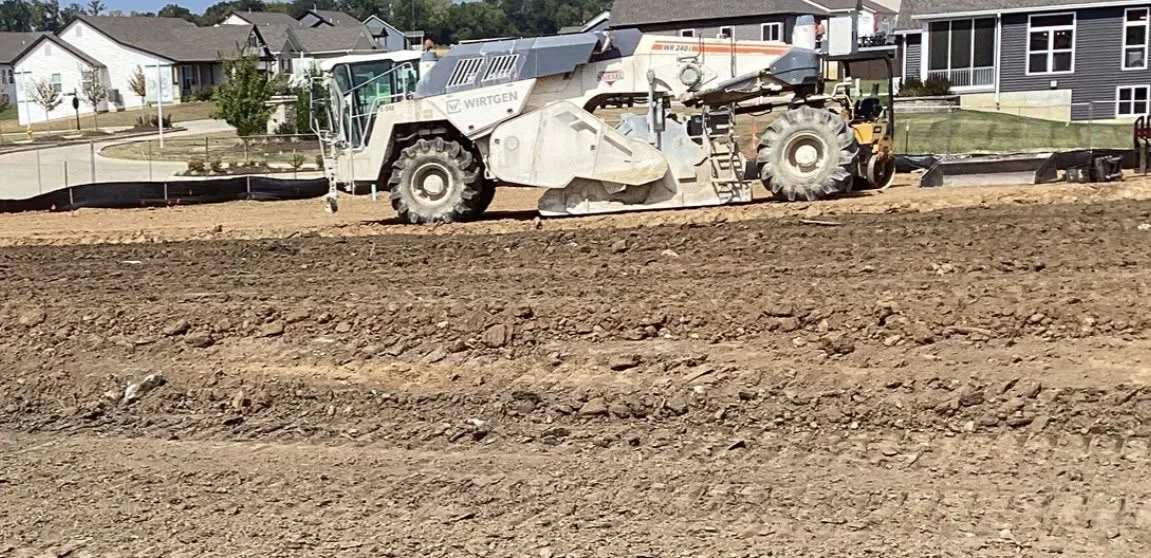
Why St. Louis subgrade stays wet
Clay and loess hold water. Between rain and freeze–thaw cycles, the windows for drying them out on their own are short.
Your options, plainly
- Wait and aerate, when the weather and schedule allow
- Dry and modify with quicklime or cement, where the engineer approves it
- Undercut and replace, for deep soft zones or unsuitable fill
We price stabilization against undercut so you can compare.
Weather-delay recovery on sites we're already on
Most of our drying is in-place subgrade on sites where we're already doing the earthwork, and weather is usually the reason. Our crews and spreader trucks are already there, so a wet pad can be dried and recompacted, with the geotech and the owner's testing agency in the loop, instead of waiting on drying weather.
Drying is usually modification
Drying with lime or cement is usually modification for workability: it lets wet soil be graded and compacted. It is not counted on for a structural value unless the engineer designs it as stabilization.
Winter and schedule
Most specifications restrict spreading in freezing temperatures and high wind, so drying is planned around the weather and the specification. Read wet soils and winter earthwork for schedule planning, or compare options in the stabilization vs. undercut tool.
Planned before spreading.
Kuesel spreads lime and cement dust-free from its own state-of-the-art spreader trucks. We also follow the specification's wind limits, use water trucks, and mix the agent in promptly after it is spread. Occupied or sensitive sites get a spreading plan agreed with the GC in advance.
Stabilization projects on the record
| Project | Client type | Location | Agent | Area / depth | Outcome |
|---|---|---|---|---|---|
| Tire Plant Phase II | Industrial (tire plant) | Clarksville, TN | Lime, about 10,300 tons | 327,817 SY — building pad 16" at 5%; pavements and rail spur 12" at 4%; laydown yards 12" at 3% | Building pad lime-stabilized at three different depths and rates, with deep equipment pits cut inside the pad. |
| Retail Pavement Cement Stabilization | National retail store | Alton, IL (Madison County) | Portland cement at 7% | About 4,300 SY at a 12-inch depth | Subgrade treated in place instead of undercut, so paving could follow. |
| University Track & Soccer Upgrade | University athletics | Columbia, MO | Portland cement | Stabilized to a 12-inch depth | Soil stabilization subcontractor with union labor; compaction by others. |
| West Plains Baseball/Softball Field (2024) | School athletics field | West Plains, MO | Quicklime at 2.5% | 11,235 SY at a 12-inch depth | Quicklime subgrade stabilization, spread, mixed and watered by Kuesel. |
| University City, MO cement-stabilized base (2023) | Available on request | University City, MO | Portland cement at 4% | 1,148 SY at a 12-inch depth (existing aggregate base) | Existing aggregate base cement-stabilized in place, with the subgrade restored to ±0.10 ft. |
More stabilization project references are available on request.
Applications
- Industrial & mission-critical pads →
Building pads and subgrade for industrial and mission-critical sites.
- Commercial pads & parking lots →
Building pads and parking lot subgrade as part of a commercial site package.
- Failed asphalt pavement →
Failed pavement and its base recycled in place with full-depth reclamation.
- Failed proof roll →
Soft subgrade that fails proof roll, treated in place where the engineer approves.
Read more.
- Stabilizing Building Pads and Paving Subgrade on St. Louis Clay →
Why local clays and loess fail, how pad and pavement goals differ, and a checklist for GCs and developers.
- Lime vs. Cement vs. Undercut →
Plain-English comparison of subgrade fixes in Missouri, with a checklist for engineers.
Common questions.
- Can you dry soil in winter?
- Sometimes. Most specifications restrict lime and cement work in freezing temperatures and high wind, so whether drying can go ahead depends on temperature, site conditions and the specification.
- Is drying the same as stabilization?
- Not usually. Drying is generally modification for workability. It becomes stabilization only when the engineer designs it to a strength target.
- How soon can grading resume?
- It depends on the agent, the specification, the weather and testing. Grading continues once the treated soil meets the spec and passes the owner's testing.
- Does drying soil with quicklime create dust?
- It can, because quicklime is a fine powder. Kuesel spreads it dust-free from its own state-of-the-art spreader trucks, and wind limits and prompt mixing add control.
- What do you need to bid?
- Send the ITB, plans, geotech report, borings and PI data, specified depth and strength targets, and quantities through Request a Bid.
Send these and we can price it.
- ITB
- Plans
- Geotech report
- Borings and PI (plasticity index) data
- Specified depth and strength targets
- Quantities