
Written and reviewed by the Kuesel field operations & estimating team
Last reviewed:
Kuesel is a family-owned site work and utility contractor based in O'Fallon, MO, building sites across St. Louis since 1963.
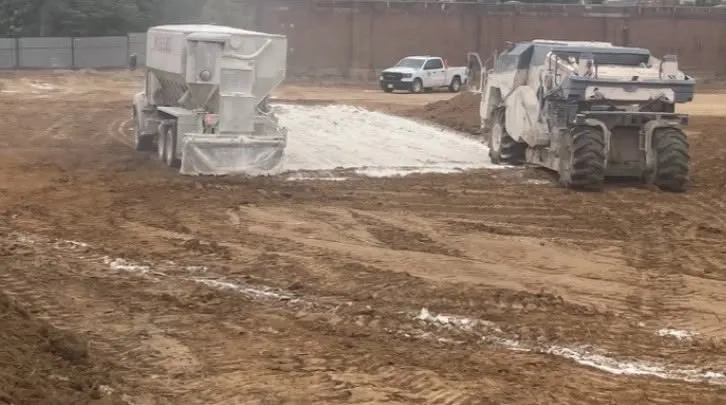
Clay and loess are the ground most St. Louis-area building pads and parking lots sit on, and they are why so many sites stall at proof roll. This guide explains why those soils give trouble, how the goals for a building pad differ from those for pavement subgrade, and what to coordinate so stabilization works the first time. For the agent-by-agent comparison, see our lime vs. cement vs. undercut guide; for how we deliver the work, see our soil stabilization services.
Why St. Louis-area clays and loess fail
- Plasticity: fat clays become soft and sticky when wet and are hard to work and compact.
- Moisture sensitivity: a soil that passes when dry can fail after one wet spell, and loess loses strength quickly when it gets wet.
- Shrink-swell: plastic clays change volume as their moisture changes, which can move slabs and pavement.
- Pumping: saturated subgrade deflects and pumps under loaded trucks during proof roll instead of supporting them.
Building pad vs. pavement subgrade goals
Under a building pad, the geotechnical engineer is usually concerned with uniform support for the slab and with limiting movement from moisture change in the clay. Under pavement, the subgrade is part of the pavement design, so the engineer may rely on a design strength value — such as CBR or resilient modulus — for the treated layer.
That difference changes the spec. A pad may only need the soil modified so it can be compacted to a stable platform, while a pavement section may need stabilization designed to a strength target. Our guide to cement-modified soil vs. cement-treated base explains how engineers specify each.
Working platforms
Sometimes the immediate need is not a design value at all — it is a surface that trucks, cranes and paving equipment can work on. Treating the top of the subgrade to create a working platform can keep a wet site moving. Whether that platform also counts toward the pavement or slab design is the engineer's call.
Scheduling around wet seasons and winter
Clay that sits exposed through a wet spring or a rainy fall often has to be dried or treated before it will pass proof roll again. Most specifications also restrict stabilization in freezing temperatures and high wind and require curing protection, so winter work needs a plan for weather windows.
Sequencing helps: open only the area that can be treated, compacted and protected in the available window, and keep drainage working so rain runs off instead of soaking the subgrade.
Coordination with the geotech, the testing agency and the paving or slab sub
- Geotechnical engineer: confirms the agent, rate and depth from the lab mix design, and whether sulfate testing is needed.
- Testing agency: field density and moisture testing, depth and pulverization checks, and proof roll observation, scheduled for when each area is ready.
- Paving or slab sub: when the treated area will be released, how long it must be protected, and who keeps traffic off it in the meantime.
Common failure modes
- Inadequate mixing depth: the agent stays in the top of the layer and the soil below it is untreated.
- Compaction delay with cement: cement starts to set after mixing, so compaction that runs past the spec's working time can leave a weak layer.
- Missed sulfate testing: sulfate-bearing soils can heave when treated with calcium-based stabilizers such as lime or cement.
- Poor drainage: water that ponds on or under the treated layer softens the subgrade around it and undoes the work.
Checklist for GCs and developers
- Geotechnical report with borings, moisture and plasticity results across pads and paving
- Lab mix design or the engineer's stated agent, rate and depth
- Whether the spec calls for modification (workability) or stabilization (a design strength value)
- Sulfate testing requirement confirmed with the engineer
- Weather limits and curing requirements from the spec
- Testing agency scope and how proof rolls will be scheduled
- Drainage plan for treated areas during construction
- Undercut priced as an alternate where the engineer allows it — see the stabilization vs. undercut tool
Questions
- Why do St. Louis pads fail proof roll after rain?
- Local clays and loess lose strength when they get wet. A subgrade that passed when dry can pump under loaded trucks after a wet spell, which is why stabilization or drying is often needed before the pad is accepted.
- Is a working platform the same as stabilized subgrade?
- Not necessarily. A working platform gives equipment a surface to work on. Stabilized subgrade is designed to a strength value used in the pavement or slab design. The engineer decides whether a platform also counts toward the design.
This guide is general information from a site contractor, not engineering advice. The geotechnical engineer of record and the project specification govern the stabilizing agent, rate, depth and testing on your project.