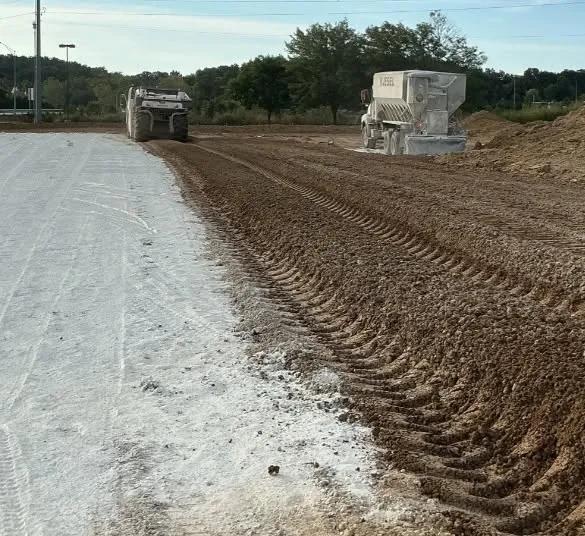
Kuesel spreads quicklime dust-free from its own state-of-the-art spreader trucks and mixes it into clay subgrade with in-house crews and owned equipment on commercial and industrial sites in the St. Louis region, to the rate and depth set by the geotechnical engineer's mix design.
Kuesel primarily uses quicklime, which suits wet St. Louis clay. The engineer of record and the mix design set the agent.
Modification vs. stabilization
Modification improves workability: the clay dries, its plasticity index drops and it can be graded and compacted, but it is not counted on for a structural value. Stabilization is designed to reach a strength value that the engineer uses in the pavement or slab design. The same lime can do either; the design intent, application rate and testing decide which one the spec is asking for.
How we build it
1Spread quicklime at the design rate, dust-free, from our own spreader trucks
2Initial mix to depth
3Mellowing period, when the spec calls for one
4Final mix
5Add water to the target moisture
6Compact
7Fine grade
8Cure
9The owner's testing agency tests the layer, and the subgrade is proof rolled
Sulfate soils
Sulfate-bearing soils can heave when treated with calcium-based stabilizers such as lime, so soils are tested for sulfates when the specification calls for it.
Weather limits
Most specifications restrict lime work in freezing temperatures and high wind, and require the treated layer to be protected while it cures. Timing depends on site conditions, temperature and the project specification.
Dust control
Planned before spreading.
Kuesel spreads lime and cement dust-free from its own state-of-the-art spreader trucks. We also follow the specification's wind limits, use water trucks, and mix the agent in promptly after it is spread. Occupied or sensitive sites get a spreading plan agreed with the GC in advance.
Project proof
Featured project: Tire plant Phase II, Clarksville, TN
On Phase II, Kuesel lime-stabilized 327,817 SY under the building pad, pavements, rail spur and laydown yards using about 10,300 tons of lime, at three different depths and rates on a pad with deep equipment pits cut inside it.
Why local clays and loess fail, how pad and pavement goals differ, and a checklist for GCs and developers.
FAQ
Common questions.
Does lime work on St. Louis clay?
Generally, yes. Lime is typically used on high-plasticity clay, which is common around St. Louis. The geotechnical report and lab mix design confirm whether lime suits a specific site and set the rate and depth.
What is a mellowing period?
It is a wait between the initial and final mixing passes that some specifications call for, so the lime can work through the clay before the layer is finished. The specification sets whether one is required.
Lime or cement for my subgrade?
As a general rule, lime is used on high-plasticity clays and cement on low-plasticity, silty or granular soils. Our lime vs. cement vs. undercut guide covers the trade-offs. The engineer of record decides which agent a site gets.
Does lime stabilization create dust?
It can, because lime is a fine powder. Kuesel spreads quicklime dust-free from its own state-of-the-art spreader trucks, and wind limits in the specification and prompt mixing add control.
What do you need to bid lime stabilization?
Send the ITB, plans, geotech report, borings and PI data, specified depth and strength targets, and quantities through Request a Bid.