
Cement Stabilization in St. Louis
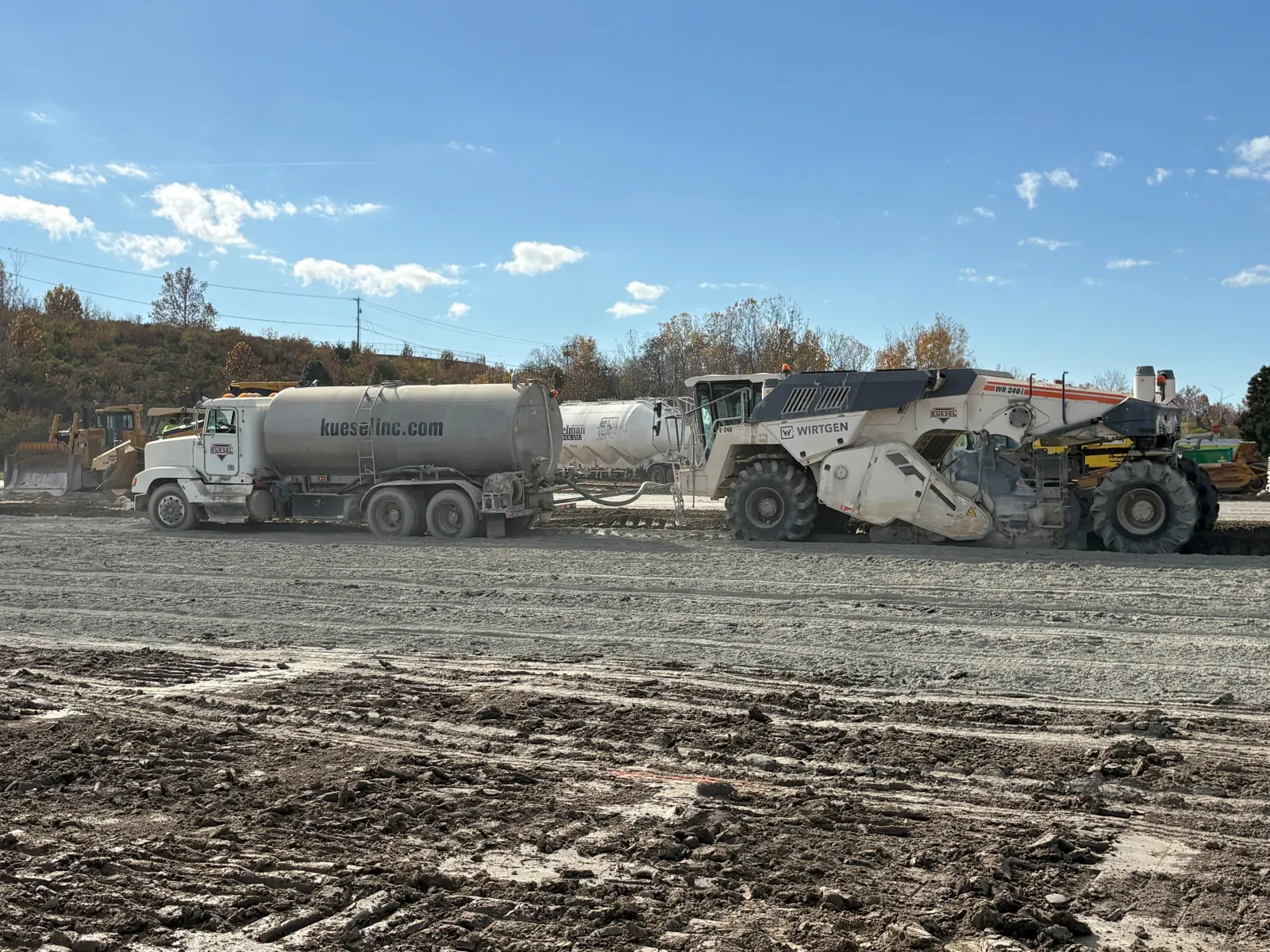
Kuesel spreads portland cement dust-free from its own state-of-the-art spreader trucks and mixes it into subgrade and base with in-house crews and owned equipment on commercial and industrial sites in the St. Louis region, to the rate and depth set by the geotechnical engineer's mix design.
When cement fits
Portland cement hydrates and binds soil particles together. It is generally suited to low-plasticity, silty or granular soils. Typical uses:
- Low-plasticity, silty or granular subgrade
- Base stabilization under parking lots, drives and roads
- Full-depth reclamation of failed asphalt, where cement is the usual agent
Working time
Cement starts to set once it is mixed with water, so compaction must finish within the working time the specification allows after mixing. That is why spreading, mixing and compaction are sequenced tightly.
Stabilized vs. modified
Cement-modified soil uses less cement to improve workability, while cement-stabilized subgrade is designed to a strength target; see cement-modified soil vs. cement-treated base. Kuesel builds strength-designed cement stabilization and does not self-perform CMS.
How we build it
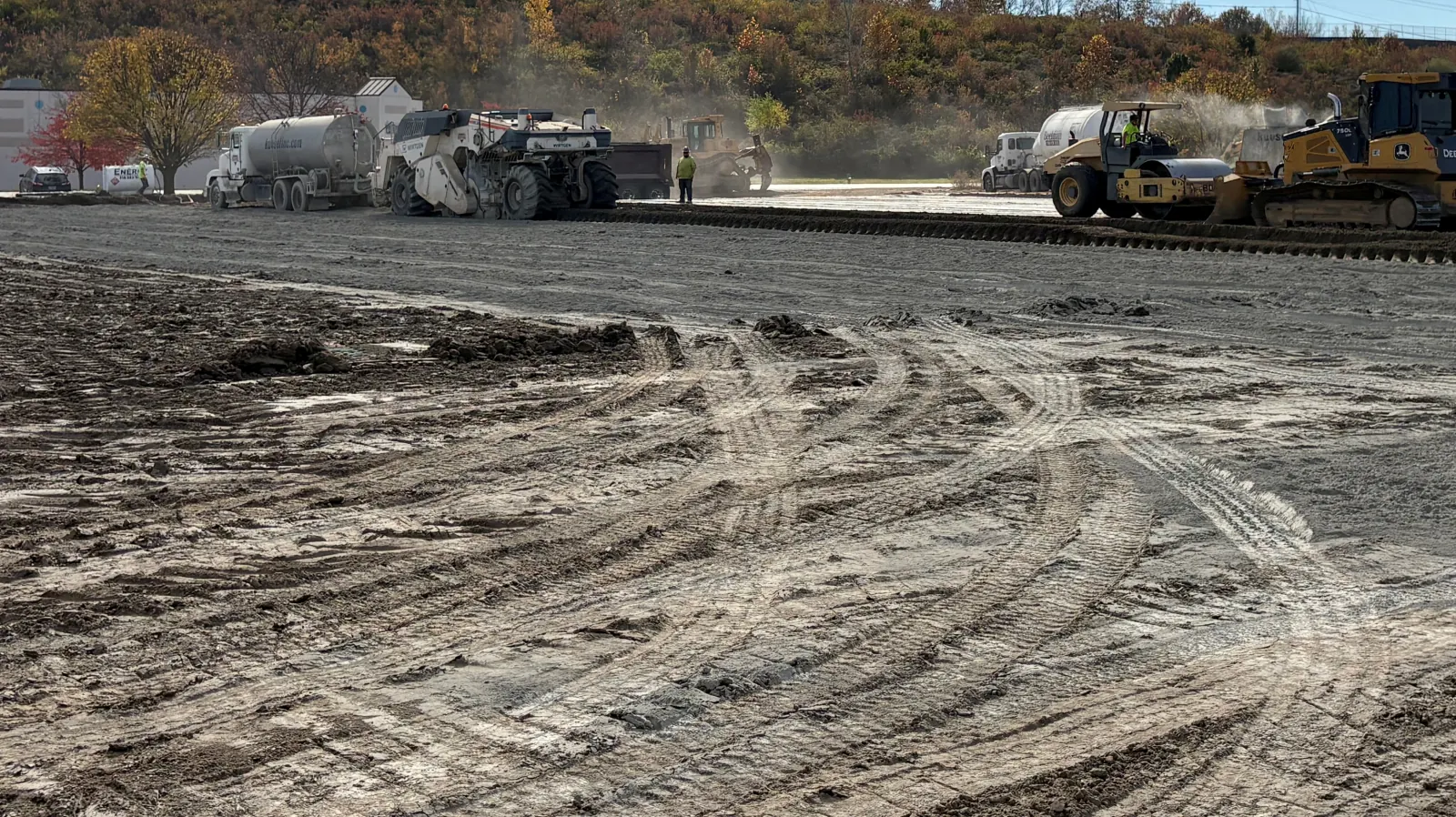
- 1Spread cement at the design rate, dust-free, from our own spreader trucks
- 2Mix to depth with a reclaimer / stabilizer
- 3Add water to the target moisture
- 4Compact within the spec's working time
- 5Fine grade
- 6Cure or seal as the spec requires
- 7The owner's testing agency tests the layer, and the subgrade is proof rolled
Weather limits
Most specifications restrict cement work in freezing temperatures and high wind, and require the treated layer to be protected while it cures. Timing depends on site conditions, temperature and the project specification.
Planned before spreading.
Kuesel spreads lime and cement dust-free from its own state-of-the-art spreader trucks. We also follow the specification's wind limits, use water trucks, and mix the agent in promptly after it is spread. Occupied or sensitive sites get a spreading plan agreed with the GC in advance.
Stabilization projects on the record
| Project | Client type | Location | Agent | Area / depth | Outcome |
|---|---|---|---|---|---|
| Retail Pavement Cement Stabilization | National retail store | Alton, IL (Madison County) | Portland cement at 7% | About 4,300 SY at a 12-inch depth | Subgrade treated in place instead of undercut, so paving could follow. |
| Tire Plant Phase II | Industrial (tire plant) | Clarksville, TN | Lime, about 10,300 tons | 327,817 SY — building pad 16" at 5%; pavements and rail spur 12" at 4%; laydown yards 12" at 3% | Building pad lime-stabilized at three different depths and rates, with deep equipment pits cut inside the pad. |
| University Track & Soccer Upgrade | University athletics | Columbia, MO | Portland cement | Stabilized to a 12-inch depth | Soil stabilization subcontractor with union labor; compaction by others. |
| West Plains Baseball/Softball Field (2024) | School athletics field | West Plains, MO | Quicklime at 2.5% | 11,235 SY at a 12-inch depth | Quicklime subgrade stabilization, spread, mixed and watered by Kuesel. |
| University City, MO cement-stabilized base (2023) | Available on request | University City, MO | Portland cement at 4% | 1,148 SY at a 12-inch depth (existing aggregate base) | Existing aggregate base cement-stabilized in place, with the subgrade restored to ±0.10 ft. |
More stabilization project references are available on request.
Applications
- Industrial & mission-critical pads →
Building pads and subgrade for industrial and mission-critical sites.
- Commercial pads & parking lots →
Building pads and parking lot subgrade as part of a commercial site package.
- Failed asphalt pavement →
Failed pavement and its base recycled in place with full-depth reclamation.
- Failed proof roll →
Soft subgrade that fails proof roll, treated in place where the engineer approves.
Read more.
- Cement-Modified Soil vs. Cement-Treated Base →
How cement-modified soil and cement-treated base differ in purpose, design and testing.
- Lime vs. Cement vs. Undercut →
Plain-English comparison of subgrade fixes in Missouri, with a checklist for engineers.
Common questions.
- How long before paving?
- It depends on the specification. Cement must be compacted within the spec's working time and then protected while it cures. Paving follows once testing and proof rolling meet the spec.
- Can cement stabilization replace undercut?
- Often, where the engineer approves it. Treating soil in place avoids hauling it off and importing replacement material. Undercut can still be the right answer for deep soft zones or unsuitable fill, and we price both so you can compare.
- Is cement used in FDR?
- Yes. Cement is commonly the agent in full-depth reclamation, where failed asphalt and its base are pulverized, stabilized and compacted in place into a new base.
- Does cement stabilization create dust?
- Cement is a fine powder, so it can. Kuesel spreads it dust-free from its own state-of-the-art spreader trucks, and wind limits and prompt mixing add control.
- What do you need to bid?
- Send the ITB, plans, geotech report, borings and PI data, specified depth and strength targets, and quantities through Request a Bid.
Send these and we can price it.
- ITB
- Plans
- Geotech report
- Borings and PI (plasticity index) data
- Specified depth and strength targets
- Quantities