
Written and reviewed by the Kuesel field operations & estimating team
Last reviewed:
Kuesel is a family-owned site work and utility contractor based in O'Fallon, MO, building sites across St. Louis since 1963.
Most commercial sites are built in roughly the same order, even when phasing changes the details. This guide walks through that sequence and ends with the coordination checklist we use with general contractors and owners. The approved plans, permits and project specifications set the actual requirements and order on your site. For the full scope we self-perform, see commercial site work.
The usual sequence
1. Clearing
Trees, brush, debris and any structures in the work area are removed so the ground can be stripped. Existing utilities are located before digging — see 811.
2. Erosion control install
Perimeter controls, inlet protection and the construction entrance generally go in before mass earthwork starts. Our construction BMPs guide covers the common measures.
3. Strip and stockpile topsoil
Topsoil is stripped from areas to be graded and stockpiled where the plan allows, to be reused on final grading and landscaped areas.
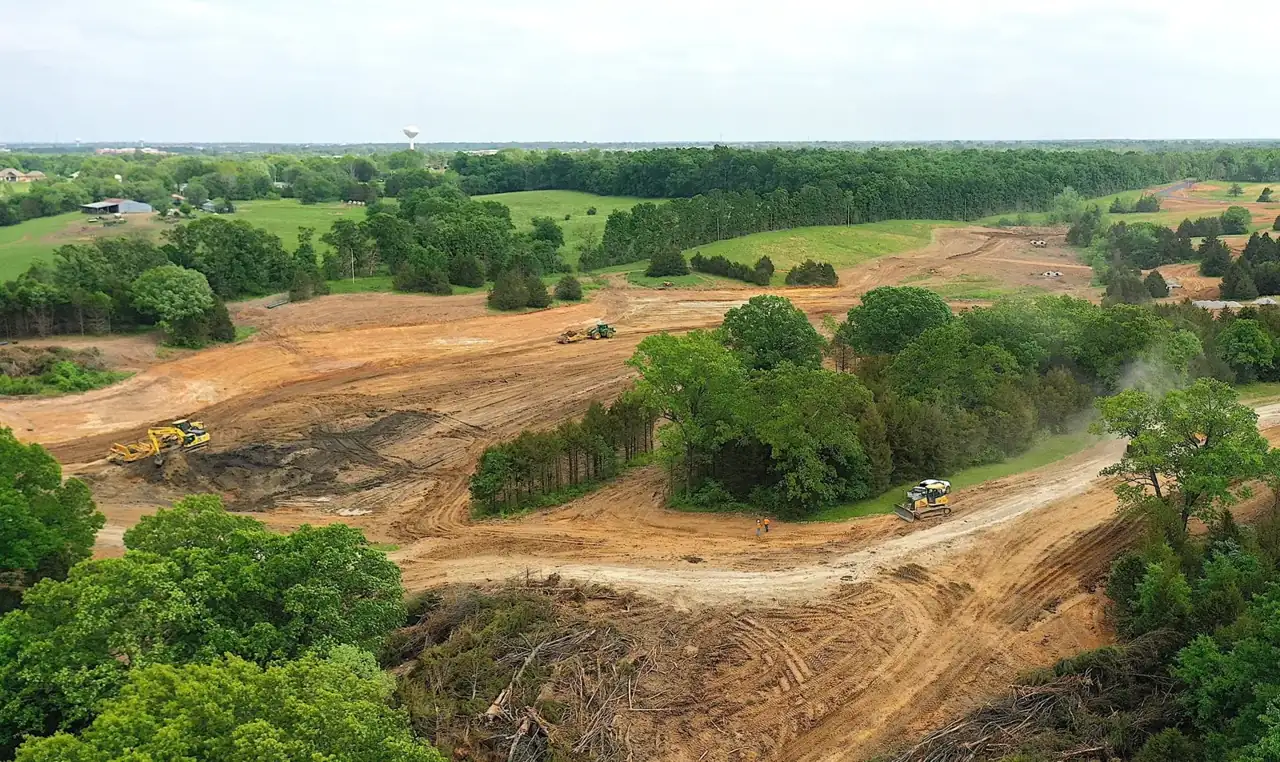
4. Mass grading
Cuts and fills bring the site to rough grade, with fill placed and compacted in lifts to the specification. Our cut and fill balance guide explains why pad elevations drive this step.
5. Utilities
Storm sewer, sanitary sewer, water and conduit are installed, usually deepest first, and tested before backfill is finished. See site utilities.
6. Subgrade prep and proof roll
Pad and paving subgrade is brought to grade and moisture, compacted and proof rolled. Areas that fail are undercut or stabilized as the geotechnical engineer directs — see lime vs. cement vs. undercut.
7. Building pad hand-off
The pad is turned over to the building trades at the agreed elevation and condition, with test results from the testing agency.
8. Final grading
After building and paving work, topsoil is spread, final grades are set and disturbed areas are stabilized.
Coordination checklist
- Approved plans, permits and the geotechnical report are on hand before mobilization
- Utility locates requested and private utilities identified
- Erosion control plan and inspection responsibility assigned
- Topsoil stockpile and spoil locations agreed
- Testing agency scheduled for density testing and proof rolls
- Utility owners' inspection and testing requirements confirmed
- Pad hand-off elevation, tolerance and condition agreed in writing
- Weather and wet-season plan for subgrade work
- Phasing and access for other trades sequenced
Questions
- Do utilities go in before or after mass grading?
- Usually after the site is at or near rough grade, so pipe goes in at the right depth and isn't disturbed by heavy earthmoving. Phasing can change that order on larger sites.
- When does erosion control go in?
- Generally before mass earthwork, as the land disturbance permit and the erosion control plan require. Confirm the timing with the plan and the permitting agency.
This guide is general information from a site contractor, not engineering or legal advice. The engineer of record, the approved plans, the permits and the reviewing agencies govern your project.