
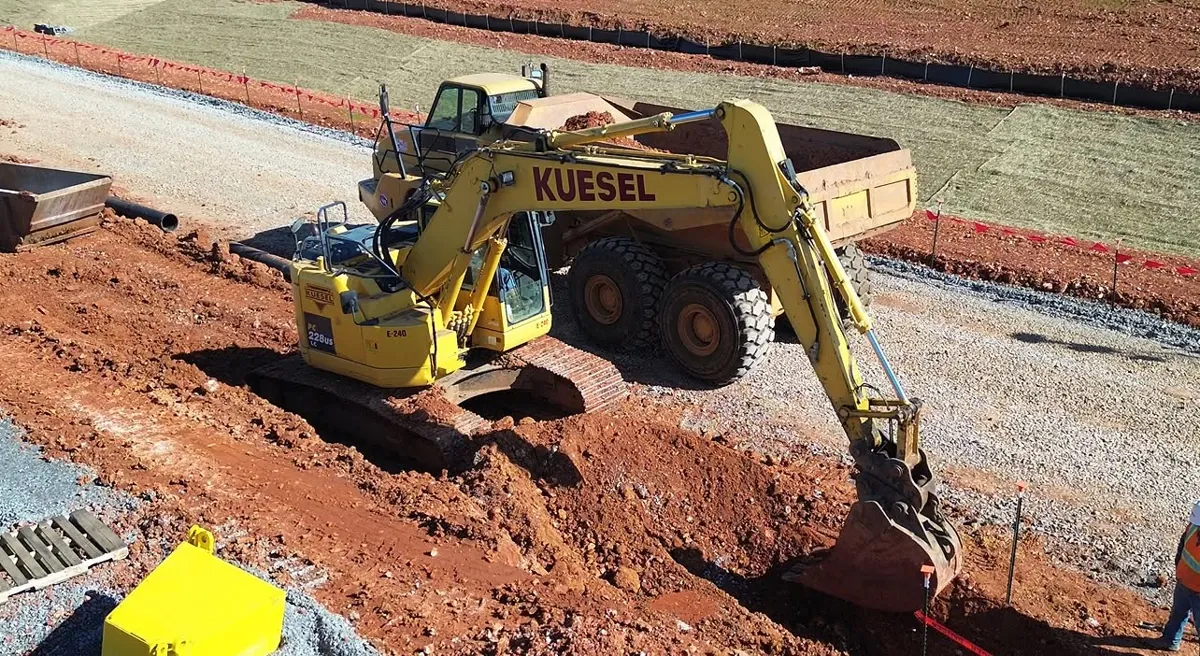
Under OSHA's excavation standard, anyone working in a trench 5 feet deep or deeper has to be protected from a cave-in by sloping, shoring or a shield (a trench box), unless the trench is cut entirely in stable rock. A trench shallower than 5 feet can go without a protective system only if a competent person has examined the ground and sees no sign that it could cave in. A trench box is legal only when it is used within the manufacturer's tabulated data, which a registered professional engineer approves. In practice, that means the box is rated for the depth and soil of the actual trench, it is set so workers stay inside its protection, and nobody is in it while it is being moved.
The rest of this post covers how that plays out on commercial site-utility work around St. Louis.
A trench rescue in Creve Coeur this summer
On August 3, 2026, a construction worker was trapped in a partially collapsed trench on Country Manor Lane in Creve Coeur. The Creve Coeur Fire Protection District chief told First Alert 4 the man was about 8 to 10 feet down and buried to his waist. There was no shoring in the trench before rescuers arrived, and the tight space made it hard to get panels in. It took the district and St. Louis County's Special Operations Team just over two hours to get him out (First Alert 4, Aug. 3, 2026).
Seven weeks later in Liberty, Missouri, rescuers needed four hours and a city hydro excavator to free a worker from a trench about 8 feet deep (KCTV5, Sept. 22, 2026). Both men survived, after hours of rescue work that a trench box or shoring would have made unnecessary.
Nationally, OSHA counted 11 trench-related deaths in the first half of 2025 alone. The agency notes that one cubic yard of soil can weigh as much as a car, and that heavy rain makes soil heavier and more likely to fail (OSHA, June 28, 2025). Trenching has been under an OSHA National Emphasis Program since 2018, so inspectors can stop at an open trench without a complaint (OSHA Trenching and Excavation).
The four numbers that decide most trench questions
Most field arguments about trench protection come down to four measurements from 29 CFR 1926 Subpart P (eCFR):
- 5 feet: the depth at which a protective system is required (1926.652(a)(1)). Below 5 feet, the exception holds only if a competent person has actually looked at the ground.
- 4 feet: at this depth, a ladder, stairway or ramp is required, placed so no worker travels more than 25 feet sideways to reach it (1926.651(c)(2)). Atmosphere testing also starts at 4 feet wherever a hazardous atmosphere could reasonably exist, such as near landfills or stored chemicals (1926.651(g)).
- 2 feet: spoil, pipe, stone and equipment have to stay at least 2 feet back from the edge, or be held back by a retaining device (1926.651(j)(2)). The same number appears in the shield rules: you can dig up to 2 feet below the bottom of a box only if the box is rated for the full trench depth and no soil is being lost from behind or below it (1926.652(g)(2)).
- 20 feet: OSHA's appendix tables for timber and aluminum hydraulic shoring stop at 20 feet. Deeper protective systems need a design from a registered professional engineer.
Why St. Louis trench walls are rarely "Type A"
OSHA's soil classification (Appendix A to Subpart P) sets how steep a trench wall can be sloped and which shoring table applies. Type A is the most stable cohesive soil, and on commercial sites in St. Louis it is easy to assume a stiff clay qualifies. The appendix rules that out more often than people expect. No soil is Type A if it is fissured, if it is subject to vibration from heavy traffic or similar sources, or if it has been previously disturbed. Soil with water freely seeping from it is Type C, the least stable class (OSHA Appendix A).
Site-utility trenches on an infill lot, plant expansion or retail pad usually cross old laterals and conduit in backfilled ground, run beside drive aisles carrying loaded trucks, and often show groundwater at the bottom. Each of those conditions lowers the classification. The safe default is to treat the soil as Type B or Type C until a competent person's visual and manual tests show it is better.
What a trench box covers, and what it doesn't
A trench box protects workers in the space between its walls. It doesn't protect anyone working beyond its ends, above its top edge in a trench that keeps going, or in a stretch of trench where a crew has moved ahead of the box. Subpart P also sets these rules for shields (1926.652(g)):
- The box can't be loaded beyond what it was designed for. Spoil piled against the outside wall counts toward that load.
- It has to be installed so it can't shift sideways if a wall lets go.
- Workers have to stay protected while they climb in and out.
- Nobody is allowed in the box while it is being installed, removed or moved vertically.
A box that is too short for the trench, or one that rides high on a sloped section without benching above it, protects the pipe layer less than he thinks it does. The tabulated data for that particular box lists its depth rating by soil type. It should be on site, and the competent person should be able to show it to you.
November is reinspection season
Under 1926.651(k), the competent person has to inspect the excavation, nearby areas and the protective system before work starts each day, as needed during the shift, and "after every rainstorm or other hazard increasing occurrence." On St. Louis jobs from late fall through spring, those occurrences are common: a soaking rain, a thaw after a hard freeze, a new haul route next to the trench, or a dewatering pump that quit overnight. Any one of them should trigger a fresh inspection before a crew goes back into a trench that was fine on Friday.
A lot of St. Louis County trenches will be open through the wet months. MSD Project Clear's Webster Groves Trunk E project is building about 5,600 feet of new wastewater pipe by open cut, starting in summer 2026 (MSD Project Clear), and the BC-01/BC-02 relief project in Ladue and Olivette is replacing about 12,600 feet of sewer starting in fall 2026 (MSD).
What enforcement looks like when it goes wrong
On April 1, 2026, OSHA proposed $4,699,362 in penalties against a Massachusetts water and sewer contractor after a November 2025 trench collapse killed one worker and seriously injured another. The citations included no safe way out of the trench, inadequate cave-in protection, unsupported underground utilities, spoil within 2 feet of the edge, shoring not installed to its design, and a damaged protective system (OSHA, April 1, 2026). Almost every item on that list is something you can check from the edge of the trench in under a minute.
A one-minute walk-up for GCs and owners' reps
You don't need to be the competent person to notice when something is wrong. When you pass an open utility trench on your site, look for these things:
- Depth and protection: if the trench is 5 feet deep or more, there is a box, shoring or a visible slope, and workers are inside the protected zone.
- Egress: there is a ladder within 25 feet of each worker, extending above the top of the trench.
- The edge: spoil, pipe and stone are at least 2 feet back, and no equipment is parked on the lip.
- Water: no standing water or seepage is being ignored at the bottom.
- Paperwork: the box's tabulated data is on site, and someone can name the competent person for that shift.
- Utilities: existing lines crossing the trench are exposed and supported rather than hanging free.
If any of these fail, ask the foreman about it before you ask anything else.
How Kuesel runs trench work
Kuesel self-performs site utilities with our own union crews, with a foreman running each crew. Every trench is protected under OSHA's excavation standards, using trench boxes, shoring or sloping as the depth and soil require, and a competent person inspects the excavation. Deep trenches, poor soils and rock are priced into the bid instead of being discovered in the field. Before the bucket gets close to existing lines, our hydrovac trucks expose them, which is how we meet OSHA's requirement to find the exact location of underground installations. The same approach applies to sanitary sewer mains and laterals on commercial and industrial sites across St. Louis and St. Charles counties.
If you have utility work coming up on a site, call Kuesel at 636-978-3478, Monday through Friday, 7:00 AM to 4:00 PM, or send us the plans. If you're a pipe layer or operator who wants to work for a crew that runs trenches this way, see our underground utility foreman opening.
This article summarizes federal OSHA rules as of November 2026. It isn't legal or engineering advice. Protective-system decisions belong to the competent person on site and, where required, a registered professional engineer.
Frequently asked questions
- At what depth does OSHA require a trench box?
- OSHA requires a protective system at 5 feet or deeper. That can be a trench box, shoring or sloping. The only exception is a trench cut entirely in stable rock. Trenches shallower than 5 feet need protection too, unless a competent person examines the ground and finds no sign of a possible cave-in.
- When is a ladder required in a trench?
- At 4 feet or deeper. A ladder, stairway or ramp has to be placed so that no worker travels more than 25 feet sideways to reach it.
- Can you dig below the bottom of a trench box?
- Yes, up to 2 feet below the bottom of the shield, but only if the box is rated for the full depth of the trench and there are no signs of soil loss from behind or below it.
- How far back does spoil have to be from a trench?
- At least 2 feet from the edge, or held back by a retaining device. Pipe, stone and equipment follow the same rule.
- How often does a trench have to be inspected?
- A competent person inspects it before work starts each day, as needed during the shift, and after every rainstorm or other event that increases the hazard.
Sources (accessed Nov 2, 2026)
Local
- First Alert 4, "Emergency crews free person stuck in trench in Creve Coeur," Aug 3, 2026
- KCTV5, "Worker rescued after 4-hour trench collapse at Liberty home," Sept 22, 2026
- MSD Project Clear, Webster Groves Trunk E Sanitary Relief Phase 2 (12276)
- MSD, BC-01 Phase III and BC-02 Phase II Sanitary Relief (12090)
National
- eCFR, 29 CFR 1926 Subpart P (1926.650-652 and appendices), current text
- OSHA, Subpart P Appendix A, Soil Classification
- OSHA trade release, "US Department of Labor urges safe practices during trench and excavation work," June 28, 2025
- OSHA national news release, Revoli Construction citations ($4,699,362), April 1, 2026
- OSHA, Trenching and Excavation overview (NEP CPL 02-00-161; 2026 Trench Safety Stand Down)
- NUCA, Trench Safety Stand Down, June 15-19, 2026