
Short answer: Rough grading (also called mass or rough-cut grading) moves and compacts the bulk of the soil so the site matches the grading plan to within roughly a tenth of a foot. Fine grading is the final trim that brings a building pad, parking lot or drive to the exact elevation and slope the slab or pavement section needs, usually within half an inch to three-quarters of an inch under a slab. The difference matters most at the handoff: whoever accepts the pad is accepting its elevation, its compaction and its drainage, so the tolerance, the survey and the geotechnical sign-off should be agreed in writing before the concrete or paving crew shows up.
What actually happens during rough grading?
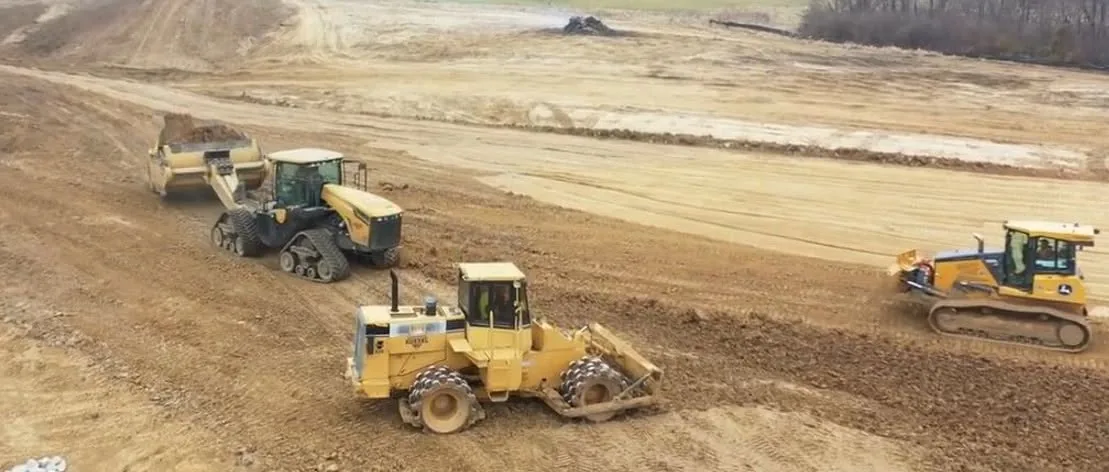
Rough grading is the heavy part of the job. After clearing, stripping and erosion control, dozers, scrapers and articulated trucks cut high ground and haul it to low ground. Fill goes down in lifts, compacted to the density in the geotechnical report while the testing agency checks it. The goal is shape and volume: pads, parking fields, swales, basins and slopes in roughly the right place at roughly the right height.
Underground utilities usually go in once the site reaches rough grade. Our commercial site prep sequence shows where each step falls.
And fine grading?
Fine grading takes the rough-graded surface and trims it to the plan. On a building pad that means hitting subgrade or top-of-stone elevation so the slab comes out at its design thickness. On a parking lot it means cross slopes and flow lines that actually drain to the inlets, and a subgrade that leaves room for the full stone and asphalt section. The equipment shifts to motor graders, finish dozers and smooth-drum rollers.
Side by side
Purpose
- Rough grading: Move volume and build the site's shape
- Fine grading: Hit final subgrade or base elevation and slope
Typical equipment
- Rough grading: Dozers, scrapers, articulated trucks, padfoot compactors
- Fine grading: Motor graders, finish dozers, smooth-drum rollers
Typical tolerance
- Rough grading: About ±0.1 ft (±1.2 in)
- Fine grading: About ±1/2 to ±3/4 in under slabs; per plan for paving
Who checks it
- Rough grading: Grade checks plus density tests by the testing agency
- Fine grading: Surveyor's grade verification plus geotech acceptance (often a proof roll)
When it happens
- Rough grading: Early, before most utilities
- Fine grading: After utilities and backfill, right before base stone, slab or paving
Tolerances shown are typical ranges, not rules; your civil plans, the Division 31 specification and the geotechnical report govern.
Where do those tolerance numbers come from?
There is no single St. Louis grading tolerance. Private commercial sites follow whatever the project specification says, and specifiers tend to borrow from a few familiar sources:
- Concrete slabs. ACI 117, the American Concrete Institute's tolerance specification, sets ±3/4 inch for the fine grade of soil immediately below a slab-on-ground. Its commentary suggests ±1/2 inch where tighter control is needed, such as industrial floors built with more precise grading equipment. The ±3/4 inch figure is tied to ACI 117's slab thickness tolerance, which allows an individual core to be up to 3/4 inch thin (ACI 117-10 text; For Construction Pros). A pad graded high therefore turns directly into a thin slab.
- Roadway-style subgrade. MoDOT's Engineering Policy Guide lists a ±1/2 inch tolerance for Class A subgrade and a 0.1-foot tolerance for Class C subgrade on finish grading (MoDOT EPG, Sec. 203).
- Rough grade under a mat or mud slab. The American Society of Concrete Contractors describes ±0.1 foot as a common rule of thumb for rough grade when a working slab goes on top, and advises concrete contractors to ask for a licensed surveyor's certification and the geotechnical engineer's sign-off before taking over a pad (ASCC).
So a pad that is "on grade" for a mass-grading crew can still be out of tolerance for a slab. The spec has to say which number applies, and when.
What should a GC have in hand before accepting a pad?
Acceptance should be a small packet of paper, not a walk across the dirt:
- A grade verification. A survey or as-built shot by a licensed surveyor, or a machine-control check the GC agreed to in advance, showing the pad or subgrade within the specified tolerance, including at slope breaks and steps.
- Density test results. The testing agency's compaction reports for each lift of structural fill, tied to locations and elevations.
- Geotechnical acceptance. The geotechnical engineer's written OK on the subgrade, typically after a witnessed proof roll. Our wet-weather earthwork post covers what to do when a pad fails one.
- A soft-area plan that was used, or is ready. If areas were undercut or treated in place, the records of where and how. For many St. Louis clays, lime or cement soil stabilization is faster than digging out and backfilling.
- Drainage proof. Pads crowned or sloped as designed, and swales and inlets taking water, so the next rain doesn't undo the work.
- A protection agreement. Who protects the finished grade from rutting, frost and other trades' traffic until base stone or concrete goes down, and who pays to re-trim it if it is damaged.
Fine grade is fragile; a pad that tested well on Tuesday can be rutted by Friday.
Does GPS machine control change any of this?
It changes how the grade is built, not how it is accepted. With automated machine guidance, the dozer or grader blade follows a 3D model of the design surface instead of stakes and string lines. The Federal Highway Administration reports that machine guidance can raise productivity by up to 50 percent on some operations and cut survey costs by as much as 75 percent (FHWA, Automated Machine Guidance with Use of 3D Models).
You can see the same approach on a public job in St. Charles County right now. The November 2026 update for the Hopewell Road improvements notes that a dozer is cutting finish grade for the new roadway, and that the masts on the dozer are survey equipment guiding the blade to exact grade (Hopewell Road project update). That is a road job by others, not Kuesel, but it shows how routine the method has become.
It also means fewer grade checkers on foot around moving iron, on sites where OSHA requires a reverse alarm or a spotter for any earthmoving machine with an obstructed rear view (29 CFR 1926.602(a)(9)).
Machine control does not replace verification. The model is only as good as the design surface, the site calibration and the subgrade underneath, so a surveyor's check still belongs in the acceptance packet.
Why does the handoff deserve extra care this time of year?
St. Louis normally gets 3.42 inches of precipitation in November, and the month's average normal high and low are 55.5°F and 37.4°F (NWS St. Louis). On clay, short drying days mean a finished subgrade can stay wet long after one storm, and a fine-graded pad that waits two weeks for the slab crew may need to be re-rolled, re-trimmed or retested. Fine grade as close to stone placement as practical, and seal the surface at the end of each day.
The market behind the schedule pressure
The work is still there for the right projects. The Census Bureau's September 2026 report put private nonresidential construction at a seasonally adjusted annual rate of $790.6 billion, up 1.1 percent from August, even as total construction spending fell 1.9 percent (U.S. Census Bureau, Nov. 2, 2026). Heavy and civil engineering construction employment reached about 1,210,800 jobs in September 2026, up from about 1,184,500 a year earlier (BLS series CES2023700001 via FRED). Crews are stretched: in the 2026 AGC and NCCER Workforce Survey, 42 percent of firms said shortages of their own or their subcontractors' workers had delayed projects (AGC 2026 Workforce Survey analysis). When labor is that tight, nobody can afford to grade a pad twice.
Kuesel's take
On the jobs we self-perform, rough and fine grading come from the same 3D earthwork model we use to price the work, with GPS machine control on our dozers so grade is built in rather than chased with stakes. We proof-roll with the GC and testing agency before turnover, and when a subgrade won't pass, we can stabilize it in place instead of waiting on undercut. If you're comparing bids, ask every grading contractor the same questions: which tolerance are you pricing to, who verifies it, and who protects it until the next trade arrives. See our earthwork and site grading services, or bring us in early through preconstruction so pad elevations, cut/fill balance and tolerances are settled before bid day.
Interested in running a grader or finish dozer on GPS? Kuesel hires operators across the St. Louis region; see our careers page.
FAQ
- What is the difference between rough grading and fine grading?
- Rough grading moves and compacts the bulk of the soil to shape the site to the grading plan, typically within about a tenth of a foot. Fine grading trims the surface to the exact elevation and slope a slab or pavement needs, typically within about 1/2 to 3/4 inch under a slab-on-ground.
- What tolerance is required for fine grading under a concrete slab?
- ACI 117 sets ±3/4 inch for the fine grade of soil immediately below a slab-on-ground and suggests ±1/2 inch where tighter control is needed, such as industrial floors. The project specification governs.
- Who should verify a building pad before the slab contractor accepts it?
- Typically a licensed surveyor verifies elevations, the testing agency documents compaction, and the geotechnical engineer accepts the subgrade, often after a witnessed proof roll.
- Do utilities go in before or after fine grading?
- Usually after rough grading and before fine grading, so pipe is set at the right depth and the final trim isn't disturbed by trenching.